

The 21st century began, in many ways, in fitting fashion: as a harbinger of things to come. The fear and panic around the Y2K bug produced vast amounts of confusion and conspiracy theories that would come to pollute our online spaces with increasing frequency.
And yet it had started out so promising: with the principle of zines taken to the next level; the web offering an unprecedented method of sharing information and ideas that had lacked coverage in the pages of newspapers and the bulletins of television news. Initially, this was often found in the online zines or weblogs ("blogs") that provided a platform for voices rarely heard up to this point.
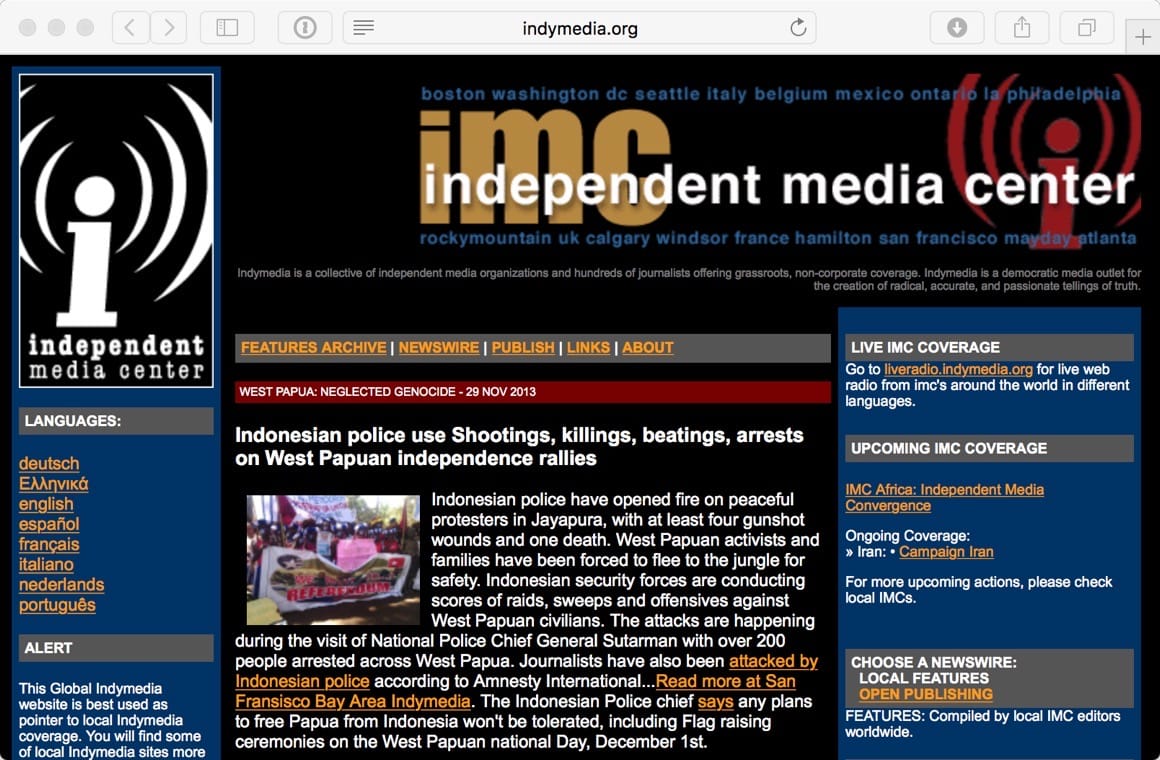
“The web dramatically alters the balance between multinational and activist media,” declared an opening statement of the first Independent Media (or Indymedia) Center. “With just a bit of coding and some cheap equipment, we can set up a live automated website that rivals the corporates’.”
Under the slogan “Don’t hate the media – become the media,” a network of Indymedia Centers spawned out of the WTO protests in 1999 and quickly expanded world-wide with the aforementioned global opposition to the 2003 invasion of Iraq, as media activists reported on actions in mere minutes, complete with photos and videos, often offering different perspectives on protests against the G8 and the G20 to those narratives provided in the papers or on TV.
My role as documentarian through my non-profit SilenceBreaker Films merged with that as an early contributor to Indymedia, reporting from protests and pickets, sit-ins and squats. On my travels researching examples of what seemed effective media activism, I visited infoshops from GlobalAware in Toronto to Adbusters in Vancouver, and made connections in the Greater Toronto Area (GTA) in particular. While still trying to keep funding coming in and hiring friends at SilenceBreaker Films back in Britain, I stayed in the GTA for months at a time – taking part in union drives, demonstrations, direct actions, and occupations, and made speeches at rallies and radical events in ways which were probably not smart for someone on temporary visas, sporadically staying in a housing co-operative with a volatile Canadian who at least shared my passion for communication studies, pursuing the subject at Wilfrid Laurier University, whose students urged me onto the board of Laurier Students’ Public Interest Research Group (LSPIRG), despite (or because of) the fact I was British and not a Canadian citizen.
It was at Laurier I was asked to give a speech for a journalism conference, where I met filmmaker Tim Knight, who stayed in contact with me for years until shortly before his death and – when I asked him about the emergence of citizen journalism – cited his fellow Torontonian, the 60 Minutes correspondent Morley Safer: “I would trust a citizen journalist as much as I would trust a citizen surgeon.” I made the counterpoint that if the modern equivalent of journalism was healthcare where the doctors were killing people instead of saving them, then you’d take your chances with someone else having a go at it – and that's where we're at, because journalists like Tim Knight rightly warned us against vested interests controlling healthcare with no irony, despite working in an industry of news media almost entirely controlled by the capitalist class.
"'The police told us to stay away,' 'The police told us to turn off the cameras.' These days, 'real' journalists often do what they're told. Good thing you're not a 'real' journalist... You deserve better. We all do." – Ales Kot
We do deserve better. But what? And how? Certainly neither example of my own media activism would prove to be an effective option.
Media Fail
Back in Britain, a colleague and friend I had trusted set about seizing the narrative – and a whole lot more – in my absence (I'd learn much later that this friend had form). As a result of this individual's influence, I was erased from our own shared history as founding directors of a community organisation called ROAR, and SilenceBreaker Films was shut down completely, with its thousands of pounds of assets allegedly transferred over to my former friend and/or those who aided and abetted the coup. The lesson here is that this was all only possible because for SilenceBreaker Films to even access grants in the first place, it still had a hierarchy: a committee in place above me, one that in my absence was influenced by my former friend, who helped ensure that the organisation’s closure was also blamed solely, squarely, and entirely on myself in my absence (even to funding bodies who subsequently blackballed me); the committee exercising their rights, without responsibility.
Meanwhile, with no such ruling body, Indymedia was experiencing a challenge at the other end of the spectrum: this global network’s non-hierarchical structure was both its strength and its greatest vulnerability.
"As the anti-globalisation movement from which it had emerged started to ebb away...Indymedia went into free fall. The open publishing nature which had allowed anybody to take part, write up action reports and publicise events, proved also to be its weakness as conspiracy theorists and anti-Semites began posting whatever they liked. It was partly in reaction to these drawbacks that we launched what eventually became libcom.org." - libcom.org
The Rise of Social Media
In addition to Indymedia’s lack of a coherent, comprehensive system of democratic editorial oversight, the "blogosphere" was at the same time being somewhat superseded by the emergence of social media sites that co-opted such features of content creation and media uploads alongside messaging and profile-building.
"Social media eventually smothered the blogosphere. I remember this time well. The harbinger of it was when blog comments dropped off. You see, the comments of blogs were really the first social networks. Every blog had 'regulars' – people who followed a blog and commented a lot. ...But then, seemingly overnight, people stopped commenting. Well, they did comment, but they just did it over on Twitter. ...Twitter became the biggest driver of traffic. I think this had something to do with a tie to identity. Comments on blogs were mostly unauthenticated – you were only identified by what you typed into the 'name' and 'email' boxes, and there was no way to verify that. But on Twitter, commenters effectively became publishers. Their comments were part of their social media account, and they were building their own audiences in that sense." - Deane Barker
Yes, profiles were increased in every way: taking advantage of the loss of faith in establishment media, commentators catapulted careers from these "platforms" – clout-chasers like Owen Jones and Aaron Bastani connecting with me online until they gained greater status and opportunities, caring so much about popularity and their online “followings” that they remained on such sites long after fascist takeovers. They weren't the only ones, either. Under the guise of offering “alternative” media, a wave of websites overwhelmed us within just a few years, leaving us with a disorientating flood of sites such as The Young Turks, MintPress News, Redfish, and The Grayzone building a reputation for fiercely “anti-imperialist” reporting – only for such coverage to be largely restricted to critiques of Western imperialism, with funds from Russian powers supporting these narratives that undermine Western superiority while platforming white supremacists and far-right conspiracy theorists.
The existence of anything questioning Western imperialism, at face value, can seem appealing to many of us, and these outlets are often designed to exploit such sentiments while being at best big state socialists, or at worst disinformation channels serving the interests of the powerful Russian government, often platforming bigots and pseudoscience personalities. But across the web, they’re all fighting for clicks, whether they be Bellingcat exposing The Grayzone as state stooges, or The Grayzone attempting to return fire by making the same claim back at them. Regardless of the influences or agendas, they’re all compromised and open to these criticisms (though some worse than others, of course). And, in order to raise and retain their profile, they’ve all been largely dependent upon traffic from pages on social media sites.
While MySpace’s purchase by Rupert Murdoch was ill-fated, it was not because social media was contracting in any way, but because it was in fact expanding: as the emerging sites suddenly rivalling MySpace attracted users in droves, what remained of the Indymedia network began to largely collapse. Facebook and Twitter were utilised for both the Arab Spring, and then the Occupy movement, which rose up after the 2008 global financial crisis (as mentioned, large banks were bailed out; large swathes of populations were subjected to harsh austerity measures). The system remained in place – essentially, it turned out, aided and abetted by the same social media powers that were supposedly useful in challenging that system.
The development of the world wide web stoked our naive expectations of a more free exchange of ideas in an online commons that was, under capitalism, quickly seized and bought up by virtual landowners. But few phenomena offer a better example of this than social media centralised, owned, and controlled by corporations.
As new media replaced old media for advertising opportunities, companies were wooed by promises of a budding target market, one all too willing to engage with brands. It became a largely accepted model: online spaces with millions – even billions – of users, all providing their data. In turn, this was sold to advertisers, creating huge profits for private social media companies. User data provided a wealth of information through profiles, polls and social graphs. Tools emerged to gauge favourite foods and films, or places a person frequented – even private matters such as sexuality and personal anxieties became figures in datasets.
Misinformation
Far from being platforms in proverbial “town squares”, as they were often lovingly referred to, these social media sites – aside from making money from selling user data to advertisers – are privately-controlled entities subjected to the whims of billionaire owners and their desire to protect the capitalist class, including by enabling the spread of misinformation.
In the run-up to the U.K. general election in 2019, a staggering 88% of Conservative Party posts on Mark Zuckerberg’s Facebook were “misleading.” (Facebook did ban one of their ads, but only because it infringed the BBC’s intellectual property rights); they went on to win that election. More recently, Covid denialism (linked heavily to the far right and nicely serving capitalist ideology) has been permitted to thrive via conspiracy theories thrown around on Facebook as well, as the “left” utterly failed to effectively emphasise the importance of ongoing mutual aid and Covid-safe workplaces, instead following along with state policy of capitalism over care; commentators and clout-chasing leftists falling over one another to race back to “normality” in an ongoing pandemic – a mass disabling event. Subsequently, conspiracy theories and right-wing authoritarians promising order increased their appeal, and were able to further their ideology of ableism and eugenics.
"The conspiracy mindset does point symptomatically to the fact that many people feel that the world is totally wrong; that our lives are lived in a way that doesn’t actually make sense and serves almost no one." - Shuli Branson, Practical Anarchism
Yes, conspiracy theories, misinformation and misleading campaigns thrived more than ever before. Even merely Scandinavian-style social democratic challenges to “business as usual” such as Bernie Sanders and Jeremy Corbyn were soon stamped out.
“Politics hates a vacuum. If it isn’t filled with hope, someone will fill it with fear.” - Naomi Klein
In countries from the U.K. and U.S. to Russia, the prevention, decimation, and eventual disappearance of even these wildly popular yet remarkably mild alternatives and tweaks to the system led populations of angry, confused, voters remaining an electorate to become seduced by something else, something different, that promised them a much-wanted drastic shake-up: a form of fascism openly promoted, for years, by a media that meanwhile engaged in an all-out assault on all things not conservative or neoliberal. This fully unleashed plague of fascism grew and spread to Brazil, Argentina, Italy, the Netherlands, and all around the world. Nowhere has been safe from these toxic elements of capitalism’s cocktail of authoritarianism utilised in an attempt to justify its principles of power, profits, and endless exploitation and extraction of planetary resources as we approach the brink of destruction. People are faced with not just worldwide inequality, but also an ongoing global pandemic and climate crisis. All the while, the capitalist system remains supposedly sacrosanct.
Anarchy!?
Then came Elon Musk.
The white supremacist billionaire, whose family made a fortune from South African apartheid emerald mining, literally believes human empathy is a "weakness" and supports far-right politicians around the world, including supposed "anarchist" Argentinian president Javier Milei (in fact, anything but an anarchist).
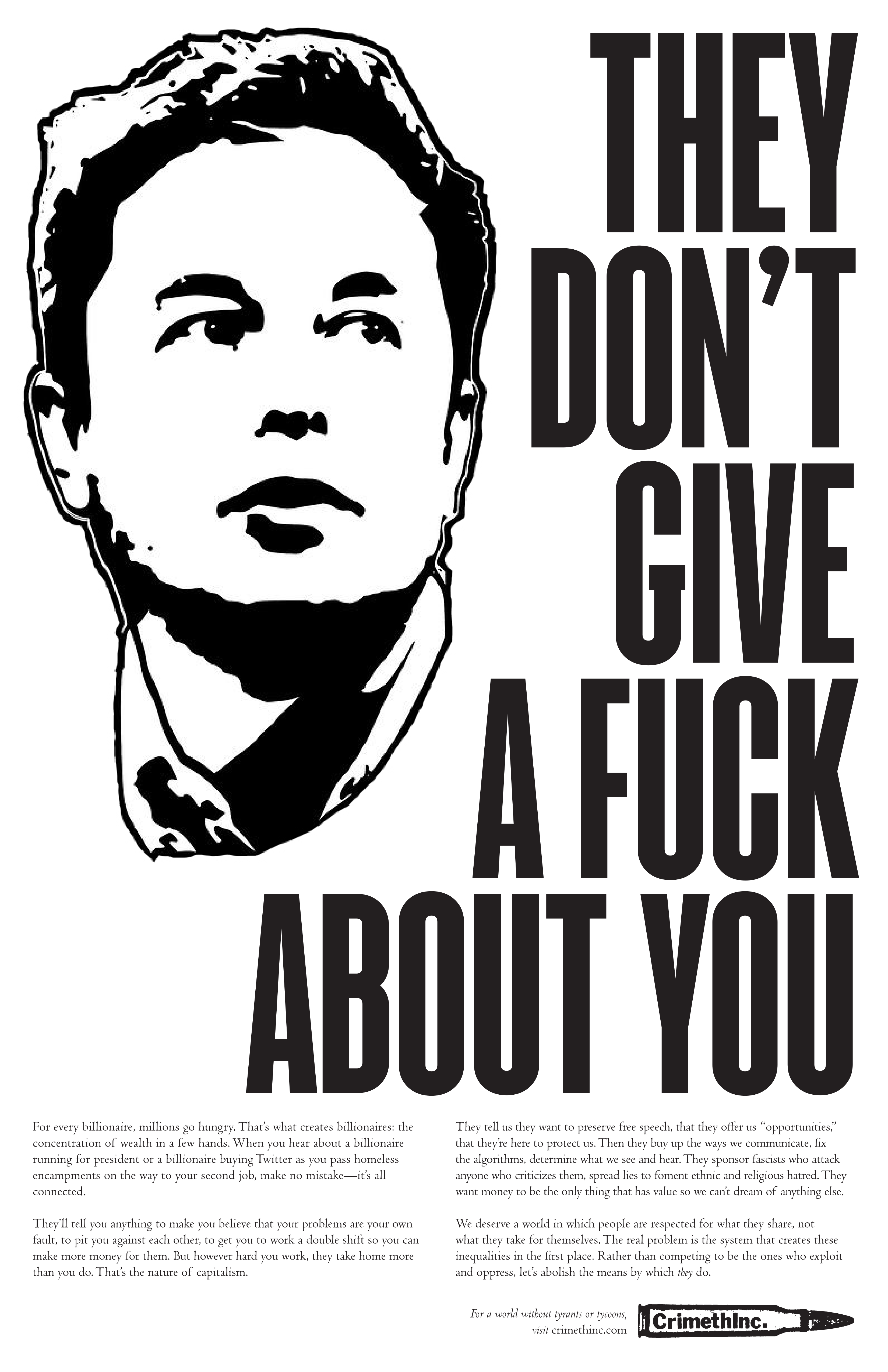
Twitter was far from perfect even before Musk bought it. Founded by Noah Glass, Evan Williams, and Biz Stone, with Jack Dorsey as CEO, it was designed to be a private entity which inevitably turned its attention towards generating revenue. When Musk purchased the service, he claimed to be a “free speech absolutist” at the same time as overseeing bans on anti-fascist accounts such as Crimethinc at the behest of the far-right voices he adheres to and even amplifies online. With capitalism accelerating global crises, and many now rejecting traditional electoral systems as realistic long-term solutions, Crimethinc is one of several similar accounts that obviously threaten billionaires such as Musk – personally, politically, and practically: they make him feel threatened because they are anarchists; the real kind. And not because true anarchism is, in fact, something threatening, at least not for us – because even though it might not offer all the solutions, it was challenging the problems exacerbated by billionaires like Musk.
“Chances are you have already heard something about who anarchists are and what they are supposed to believe. Chances are almost everything you have heard is nonsense. Many people seem to think that anarchists are proponents of violence, chaos, and destruction, that they are against all forms of order and organisation, or that they are crazed nihilists who just want to blow everything up. In reality, nothing could be further from the truth. Anarchists are simply people who believe human beings are capable of behaving in a reasonable fashion without having to be forced to. It is really a very simple notion. But it’s one that the rich and powerful have always found extremely dangerous.” – David Graeber
Anarchist philosophy teaches us that the state is another concentration of powerful interests, with its hierarchy of institutions, armed forces, policing over its people, and often punitive welfare systems where, while elites hoard their immense wealth, people scramble for scraps of assistance to experience a life less miserable – assistance that can be withdrawn at the whims of a government whose politicians swap, switch, and change positions, portfolios, and policies in the corridors of power; policies that can remove support for swathes of people with the mere flick of a pen; no sword even needed to commit this kind of violence. And that’s exactly what it is.
"Read and learn. You'll see how many ways there are to kill." - Libertarias
We all tend to agree that refusing to help place food within reach of the needy when we have the chance is still a form of starvation through cruelty of inaction. It causes easily avoidable harm. So these policies are state violence. And there is a term for the perpetrators: desk murderers. These people in power already killed many people, all without ever having to dirty their hands. Austerity continues, yet if the needy take food from a market without paying for it, the state ensures that they are arrested, prosecuted, and punished.
"The greatest crimes in the world are not committed by people breaking the rules but by people following the rules. It’s people who follow orders that drop bombs and massacre villages." - Banksy
With justification, anarchists like to point out that the hierarchy of the state means power is concentrated at the top of a centralised system, almost always comprised of people achieving such power usually by having worked with others in powerful positions – perhaps their predecessors, maybe other hierarchical institutions including city councils, the police, or the military. In countries where the state embraces corporatism, many politicians are lobbied or even financed by corporate interests, and even if they happen to have introduced laws to supposedly stop corporate abuse, these big companies can get away with it through a form of legalised bribery known as government fines.
"The purpose of getting power is to be able to give it away." – Aneurin "Nye" Bevan
Even the few anti-capitalist politicians with seemingly good intentions have always historically found themselves at the mercy of powerful interests domestically and globally – if not sabotaged or smeared by agents of capitalism, then certainly seduced or trapped by the power of the state; compromised or even corrupted. No surprise, then, that not one has ever succeeded through our entire history, and no government has ever liberated all of its people from oppression.
"Our present economic system is more likely to reward people for selfish and unscrupulous behaviour than for being decent, caring human beings. ...Most people don’t think there’s anything that can be done about it, or anyway — and this is what the faithful servants of the powerful are always most likely to insist — anything that won’t end up making things even worse. But what if that weren’t true? And is there really any reason to believe this? When you can actually test them, most of the usual predictions about what would happen without states or capitalism turn out to be entirely untrue. For thousands of years people lived without governments. In many parts of the world people live outside of the control of governments today. They do not all kill each other. Mostly they just get on about their lives the same as anyone else would." – David Graeber
As Eric Laursen explained in the book The Operating System: "In the past century, the atrocities have grown in magnitude as the State has grown more powerful: over six million killed in Nazi Germany's death factories, millions imprisoned and dead in the forced labour camps of the Soviet Union and Maoist China, and an unprecedented incarceration boom in the United States that's created a powerful new private industry of prisons and detention centres." Yes, as history judges the state, the verdict becomes damning indeed. When we think of Joseph Stalin or Adolf Hitler, or even Donald Trump, we know that their incredible power, oppressive might – and atrocities – were only ever possible because of something we have quite remarkably been conditioned to take for granted: the state. Nation state power blocs trap the world's population (and even the best possible politicians) within walls, and prevent human harmony and progress, instead increasing the threat of nuclear war and climate collapse through their very existence and the "us and them" conflicting interests of geopolitics.
Elections offering a choice between "red" and "blue" is like picking between Coke and Pepsi – whichever we choose, it's essentially the same thing, and it's still bad for us. While people for years have argued with one another about political parties across the spectrum, it turns out that perhaps the biggest problem of all wasn’t so much to be found on a horizontal line of “left” or “right” politicians in the halls of power, but at the top of a vertical line – of those holding power over the working class “subjects” or “citizens” beneath them. "Socialist" Joseph Stalin and "National Socialist" (Nazi) Adolf Hitler were able to carry out their atrocities because the problem was a concentration of power itself – take away that concentration of power, and you take away their ability to commit such crimes against humanity on a large scale. Karl Marx, who presumably would have been disgusted at the crimes committed in his name, actually suggested "a withering away of the state", but anarchists are bolder, suggesting that a line must never be vertical, and only be horizontal when it’s endlessly representing all people – essentially joined in a circle.
"Most of us have little experience in groups where everyone gets to make decisions together, because our schools, homes, workplaces, congregations, and other groups are mostly run as hierarchies. Our society runs on coercion. You have to work or go to school and follow rules and laws that you had no say in creating, whether you believe in them or not, or risk exclusion, stigma, starvation, or punishment. We do not get to consent to the conditions we live under. Bosses, corporations, and government officials make decisions that impoverish most people, pollute our planet, concentrate wealth, and start wars. We are only practiced at being allowed to make decisions as individual consumers, and rarely get practice making truly collective decisions. We are told we live in a system of 'majority rule,' yet there is rarely anyone to vote for who is not owned by – or part of – the 1 percent, and the decisions those leaders make do not benefit the majority of people." - Dean Spade
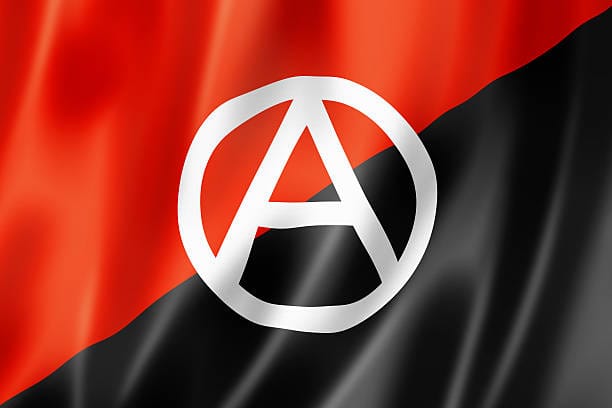
The word “anarchism” derives from the ancient Greek word anarchia, which basically means “without leader” or “without authority.” No lines, only circles. Pierre-Joseph Proudhon once stated that “anarchy is order without power,” a phrase that many understandably assumed to have inspired the symbol of the letter “A” inside a circle. But what kind of order does it offer society?
Revolutionary Vision?
“We have nothing but our freedom. We have nothing to give you but your own freedom. We have no law but the single principle of mutual aid between individuals. We have no government but the single principle of free association. We have no states, no nations, no presidents, no premiers, no chiefs, no generals, no bosses, no bankers, no landlords, no wages, no charity, no police, no soldiers, no wars. Nor do we have much else. We are sharers, not owners. We are not prosperous. None of us is rich. None of us is powerful. If it is Anarres you want, if it is the future you seek, then I tell you that you must come to it with empty hands. ...You cannot buy the Revolution. You cannot make the Revolution. You can only be the Revolution. It is in your spirit, or it is nowhere.” ― Ursula K. Le Guin
You might be wondering what our world might look like without nation states, and even concerned that undoing the oppressive destruction of the state might also mean going backwards in time, not just before the state a few thousand years ago, but to pre-industrial times. What about our remarkable medical and technological advances? So many people say "Oh, you're against capitalism, yet you have a smartphone!" As my partner has always pointed out: those who say such things are confusing production with the means of production. Capitalism is about ownership, not the production process. But what are our options for a post-capitalist world? How can modern society be organised differently, beyond the sham of democracy as we now know it? It's often easier to declare what we're against than it is what we're for, and anarchists struggle with this too.
"People always say anarchy can't work because you can't trust people to rule themselves. To which I've always said, if people are untrustworthy as all that, how can you trust them to rule one another? You can't." ― Margaret Killjoy
"The only people who are actually afraid of these collective ways of organising are the politicians, cops, and corporations who seek to preserve their absolute power over humanity," stated a dozen of the sixty-one "Stop Cop City" activists. "If we had ways of living more collectively, satisfied our needs through mutual aid, and had solidarity with each other, people may realise they don’t need the state or capitalism, and they may realise that the greatest causes of human suffering and barriers to freedom and security are the state and capitalism." Theirs was a decentralised movement protecting a forest in opposition to the Atlanta Public Safety Training Center being developed. One protester was shot dead. As extreme as that may seem, it's actually part of a long tradition of state violence on those of us who even peacefully oppose it – because states are so incredibly threatened by mutual aid and solidarity: concepts with potential to de-legitimise, undermine, or even possibly somehow replace the state itself. It’s why the rise of fascistic right-wing violence is generally greatly ignored. It’s why, instead, peaceful campaigners can be called “domestic extremists,” cute bookstores can be considered “hotbeds for terror plots,” an activist can be imprisoned simply for attending an “anti-state dinner,” an urban farm can be raided for “conspiring” to provide compost toilets and a wheelchair track to a peaceful climate camp, and it’s why the free breakfasts provided by the Black Panthers were considered a “security threat.” As Shuli Branson pointed out in the book Practical Anarchism: “The state will object to even simple kindness or humane treatment if it isn't concentrated through its own power.”
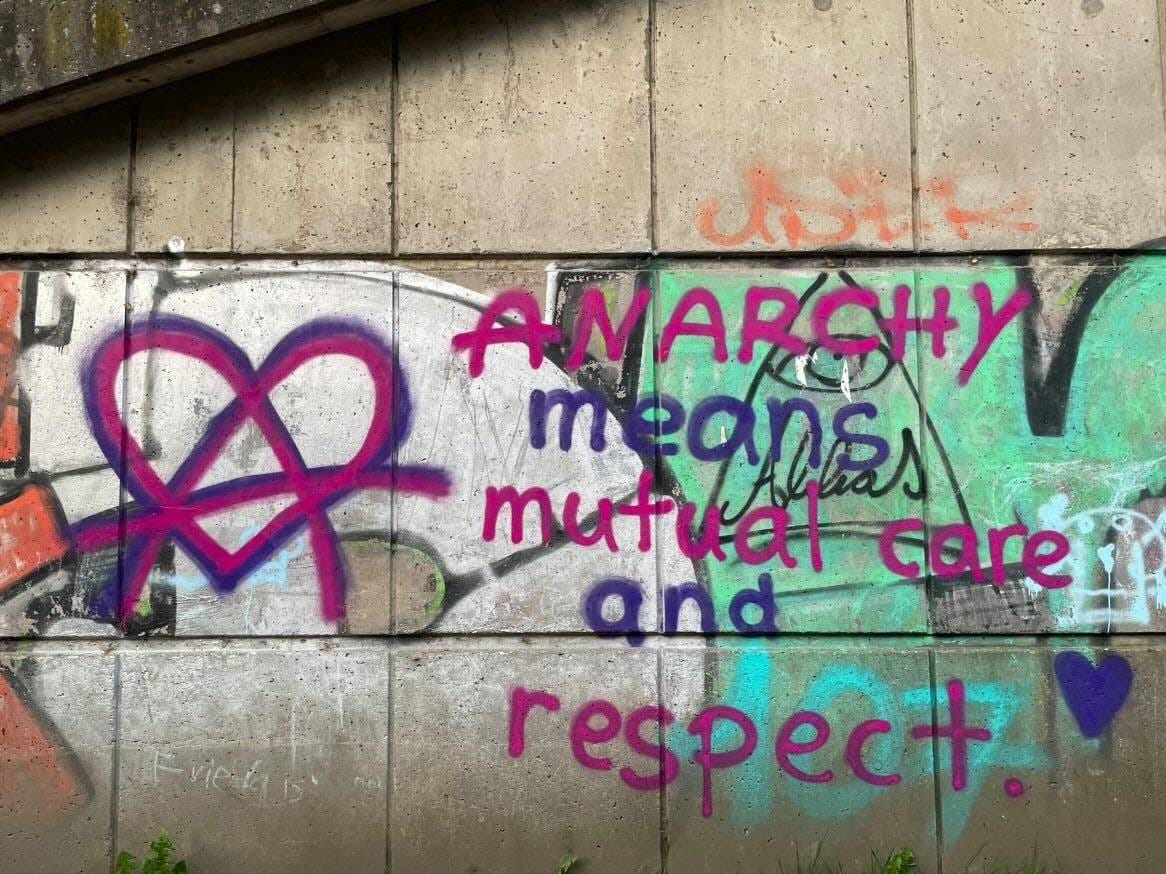
There is hardly any wonder Elon Musk, his capitalist class, careerist politicians and presidential candidates are so offended by such harmonious, horizontal ways of organising society: these ways mean less power for such interests, and instead ordinary people doing things and deciding for themselves, rendering the current system of hierarchy completely exposed, and ultimately useless. For now, the current system means these interests call all the shots. At its worst, the state itself actively stamps out such solidarity and mutual aid (which is unconditional and horizontal), while at best promotes charity (which often has conditions and is hierarchical). The state is defined by power itself. And, of course, power protects itself.
"Existing political elites and the ruling classes have a vested interest in keeping things as they are, even if that means the continued murder of Black people by police, foreign military intervention, and a dangerously escalating climate crisis. They will not voluntarily give up power and share the wealth, as has been demonstrated throughout history." - Dana Ward and Paul Messersmith-Glavin
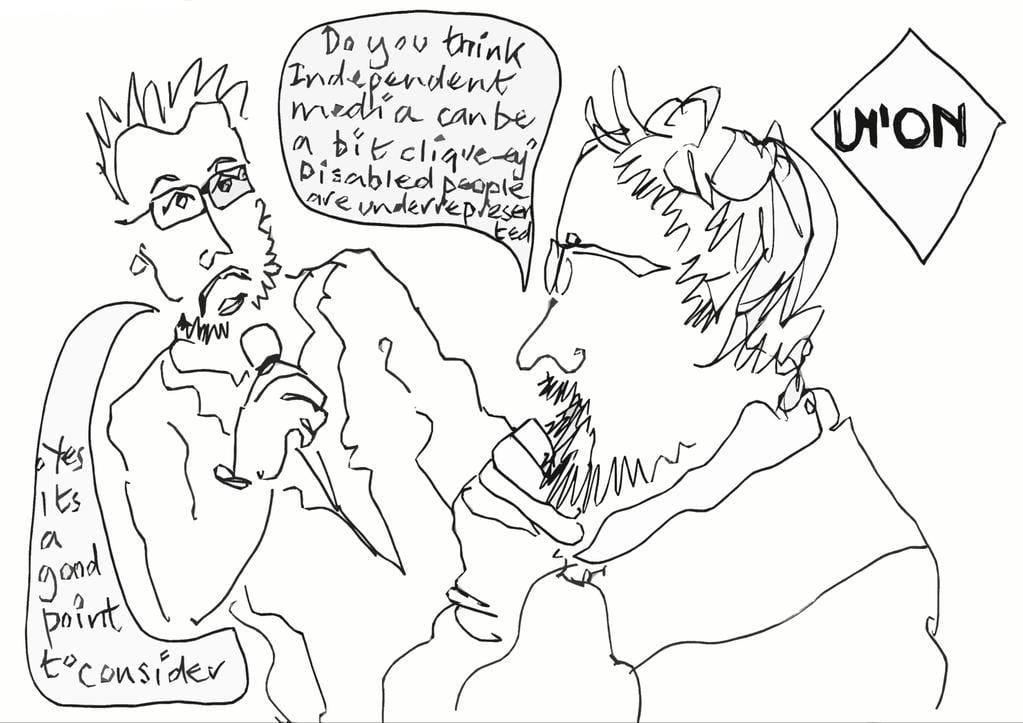
In my formative years of activism, I personally operated alongside many anarchists in campaigns against war, racism, borders, and fascism, often without even realising it; I too had wrongly assumed the anarchist "black blocs" of protesters were just nihilists there to smash things up. The few I came to know still insisted on taking about what they opposed rather than what they proposed; often, they preferred to propose nothing at all, and spoke with exclusionary language, leaving my friends and I none the wiser, speaking about us in condescending tones for engaging in party politics while offering no alternatives; seemingly content to remain an "edgy" and "cool" clique.
Fortunately, I eventually found out about anarchism for myself after understanding the scourge of hierarchy in organisations, boardrooms, and governments, recognising the paradox of liberatory socialism through electoral politics that I had experienced firsthand – having voted for the UK's Labour Party for the first time in 2010 due to the threat of something worse (Conservatives and subsequent austerity), I then joined and, as a member, voted in Jeremy Corbyn, twice, as the party's leader, and we all know how that turned out: saboteurs, smear campaigns, and an establishment media mobilising against even the slightest shift towards Scandinavian-style social democracy, all to protect the capitalist status quo, even if it meant them accepting fascism. But ultimately, as with Bernie Sanders in the United States, Jeremy Corbyn's downfall was orchestrated largely within his own party.
"If you talk to Corbyn’s most ardent supporters, it’s not the man himself but the project of democratising the party that really sets their eyes alight. The Labour party, they emphasise, was founded not by politicians but by a social movement. Over the past century it has gradually become like all the other political parties – personality (and of course, money) based, but the Corbyn project is first and foremost to make the party a voice for social movements once again, dedicated to popular democracy (as trades unions themselves once were). This is the immediate aim. The ultimate aim is the democratisation not just of the party but of local government, workplaces, society itself...For Corbynistas, the fact that he is in no sense a rabble rouser, that he doesn’t seem to particularly want to be prime minister, but is nonetheless willing to pursue the goal for the sake of the movement, is precisely his highest qualification. While one side effectively accuses him of refusing to play the demagogue during the Brexit debate, for the other, his insistence on treating the public as responsible adults was the quintessence of the 'new kind of politics' they wished to see." – David Graeber
By the time of the Covid-19 pandemic that disabled my partner, and Black Lives Matter in 2020 – with the campaigns of Bernie and Corbyn derailed, dead and buried – the bitter taste it left behind made me relate to anarchists more than ever. I began to argue that, while it takes a few minutes to vote, doing so merely legitimises this system when the major candidates (Trump/Harris, Starmer/Sunak, etc) all protect the same interests dooming the planet. As acting secretary, I had helped re-establish a branch of the IWW for my subregion, leading me to meet other members (known as "Wobblies") who were also ex-Corbynistas, agreeing that the exhausting struggle of Corbynism absorbed many energies that we could all now redirect to more radical means outside the system of party politics that was back to business-as-usual choices between one capitalist spokesperson and another.
What I didn't relate to was anarchists who expended energy on rejecting, even attacking, party political opposition to fascism through voting in mere minutes. These anarchists still seemed to be living in an outdated fantasy of a fascist dystopia leading to some sort of magical collective awakening and revolution, demolishing hierarchy and leaving us with a world of...well, what? For one thing, we would be mourning mass death and destruction through fascism – not to mention also as a result of the violent uprising it would supposedly bring about. (Perhaps not coincidentally, most of these anarchists were much more privileged than myself, in much more comfortable positions, and much more able to withstand the brunt of fascism than me or my partner). Surely there had to be a brighter vision that this?
"The word revolution, which has come to mean a disruptive change in an order, also contains the meaning of a return. This image could be seen in the repeated power changes in unstable regimes. But the current idea of a revolution we use relies on a linear view of history, which as Hannah Arendt points out in On Revolution develops from the Christian timeline of the unique event of the coming of Christ. This coming is the beginning point of history – and revolution would be an end-point (modeled on the apocalyptic Revelation), like the famous end of history claimed by the capitalist nations after the fall of the Berlin Wall. But if revolution posits a total change of order, a new world, we might ask how we ensure that the new world is good and lasting. The anarchist response is we don't and we can't!" – Shuli Branson
I had contributed to anarchist media outlets that were, under the premise of secrecy from the state, surprisingly unaccountable and non-transparent. I had written for Organise Magazine and Freedom News, who frustratingly ran – and still run – highly questionable (in some cases unsourced, even wholly false) hit pieces on well-intended socialist politicians offering alternatives to fascism in the current state system; pieces that took time and energy to belittle and dismiss emerging parties whose politics offer here-and-now hope in the face of fascist threats; pieces at the same time offering few suggestions besides literally: "a visit to a munitions factory, organising in our communities against deportations, building mutual aid networks…it’s up to the person or peoples to decide." Again, hardly a radical vision that inspires.
Even in the IWW – possibly the last place you'd expect it – there remained a shocking amount of trust in government pandemic policy from "anarchists" keen to abandon Covid precautions, failing Disabled people like my partner. An attempt to set up a "Local" of the similarly anarchist but broader Solidarity Federation rendered similarly disappointing results. Many of these "anarchists" seemed far less interested in the proposed "mutual aid networks" when it came to mask blocs – such as the one I was involved with to unconditionally distribute free respirators and tests in an ongoing pandemic that was a mass disabling event. In fact, many much preferred to unmask and have their faces in plain view on demonstrations and social media to add to their "edgy" and "cool" credentials, abandoning the few remaining maskers to get easily spotted and snatched by police rather than "holding the line" in solidarity, as protest itself came under attack.
This is not a reflection on all anarchists, let alone anarchism itself – the so-called "beautiful idea" that is debated and enacted all around the world, standing up to state power and doing a great deal of good in communities. However, it is a reflection on an ideology that seems so open to interpretation that it enables these situations to arise again and again.
"Anarchism – which, I believe, represents in its authentic form a highly individualistic outlook that fosters a radically unfettered lifestyle, often as a substitute for mass action – is far better suited to articulate a Proudhonian single-family peasant and craft world than a modern urban and industrial environment. I myself once used this political label, but further thought has obliged me to conclude that, its often-refreshing aphorisms and insights notwithstanding, it is simply not a social theory." – Murray Bookchin
The absence of a clear vision may even explain the opening for nihilists, "anarcho-capitalists," and even grotesque figures like Javier Milei himself to be portrayed as anarchists. One of the biggest factors in the destruction of Corbynism was the Labour party's rejection of its "democratic socialist" definition on its membership cards in favour of its more dominant rhetoric of being "a broad church" that enabled pro-capitalist factions to bring down Corbynism from within. Not that Corbynism would have solved the problems of the global economic system, finance, geopolitics, armed forces, and policing, as much as its "Momentum" campaigners pushed for greater grassroots democracy. Today, the rise of Green parties around the world offer hope, but only for damage control. There has to be another way; a better vision. We have to reject dystopia, but also demand utopia in a world that, as mentioned, already gives us all the resources for every human being to live a dignified life.
After so many sour experiences, full of negativity, and little hope, I did something that changed me – as it had many others around the world who had done the same.
I googled Murray Bookchin.
"Bookchin is no grim puritan. I first read him as an anarchist, probably the most eloquent and thoughtful one of his generation, and in moving away from anarchism he hasn’t lost his sense of the joy of freedom. He doesn’t want to see that joy, that freedom, come crashing down, yet again, among the ruins of its own euphoric irresponsibility." – Ursula K. Le Guin
PART 3 COMING SOON.