

"If your dream is only about you, it's too small." - Ava DuVernay.
Humans like stories. We also like to think of our lives as stories — usually ones of career, accumulation of wealth, property, and retirement. You won't find that here. I dislike capitalist definitions of "success" and have instead come to perceive life as simply a series of moments — of experimentation, of failure, of adaptation, and of wisdom too, if we're lucky. We can live in those moments in ways that help create the better world we want.
Born in the British mining town of Doncaster at 332 ppm, I came into the world the same year punk itself exploded onto the scene to uphold the ethos of “D.I.Y.” as VHS (and home taping) also arrived, all about to be joined by the anti-authoritarian, industry-changing comic books of 2000 AD I'd come to love.
Sure enough, I was raised to adhere to the punk principle of “do no harm, take no shit,” particularly instilled in me at the age of eleven when I was pulled from an abusive school environment, and — while the man I believed to be my dad worked longer shifts at the nearby factory — I was taught at home by my mother, who battled education authorities in order to do so. I kept that man’s surname, but changed my forenames to be gender-neutral, and became a vegetarian (and later vegan), supported in all these decisions by my mother, who by the time I reached my teenage years, marched right beside me on my first political demonstration. Much like Andrewism's Andrew Sage, who was also home-schooled, I would often draw and write concepts for alternative visions of the world we live in.
Spending these formative years being educated by a working class woman helped form my intersectional feminism, despite living in Conservative Britain in the 1980s while a very different kind of woman – prime minister Margaret Thatcher – attacked the unionised industries our communities had been built on. Partly due to the propaganda around the miners' strikes, the television was another box I'd grow to detest; I rejected its "programming" built around the daily routine of "Alarm Clock Britain," and by the 1990s was far more interested in the internet from the moment I first logged on after booking a corner computer in the library of Doncaster College, where my mother had “accidentally” enrolled me with the wrong date of birth, in truth so I could pursue qualifications sooner than the system would usually accept me.
Unused to hierarchical, one-size-fits-all learning environments, I was barely able to exist in formalised further education and into higher education, scraping by with supporting statements from media tutors who apparently felt I possessed a worthwhile, reasonably unique understanding of their subject, leading me to being accepted onto a three-year media degree at Barnsley College. Nonetheless, it took its toll on my mental health and I dropped out with just a few months left, taking away the lesser diploma from the University of Leeds. Signing on "the dole," my only plan at that point of the new millennium was to somehow simply avoid being in a box: cardboard, concrete, wooden, or just metaphorical, but I was placed on Tony Blair’s welfare-to-work programme working weekdays for social security payments for most of the year while volunteering in youth centres some evenings, before being hired to work for Rotherham Council as a youth and community worker in the multimedia department. As that work was winding up, I set up the grassroots, not-for-profit SilenceBreaker Films and eventually started filming my own guerrilla documentaries.
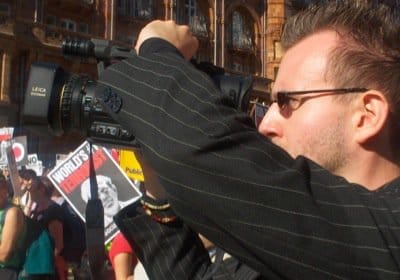
I attended the historic February 15th, 2003 march in London protesting Blair’s invasion of Iraq alongside over a million more of my fellow protesters and for many months documented much of the movement for Indymedia while attending meetings and actions around anti-war activism and opposition to oppression linked to such wars: imperialism, colonialism, racism, and of course capitalism itself. It was on this scene that people first introduced me as their friendly neighbourhood “media activist,” the first time I’d ever even heard the term. Suffice to say, it stuck.
The fascist doxing website Redwatch then branded me a "public enemy" as I became more known, having launched my own blog (still here!) and screened my documentaries, for which I interviewed the likes of Kate Wilson, Prem Sikka, Teresa Hayter, Peter Tatchell, Shami Chakrabarti, Richard Murphy, Kate Pickett and Richard Wilkinson, in addition to many more campaigners, academics, and activists.
On numerous trips to Turtle Island I had visited media activist infoshops from GlobalAware in Toronto to Adbusters in Vancouver before graduating from the School for Social Entrepreneurs (Class of 2010) in Leeds, the city where I met my eventual partner Jane Watkinson after writing for the same publication, as she gained a first class BA degree in Sociology from The University of Leeds before passing with Distinction her Masters in Politics With Research Methods at The University of Sheffield, since we both now resided in the "Steel City." We combined and utilised our experience and skills to help launch several social enterprises, including SilenceBreaker Films' successor SilenceBreaker Media officially incorporated as a not-for-profit limited company, which later spawned other initiatives on a life of their own, as meanwhile we pushed for more anti-hierarchical ways of working and since decades later the “SilenceBreaker” name became far too synonymous with my own. I am now developing a worker-controlled, anti-Big Tech non-profit called The People's Tech.
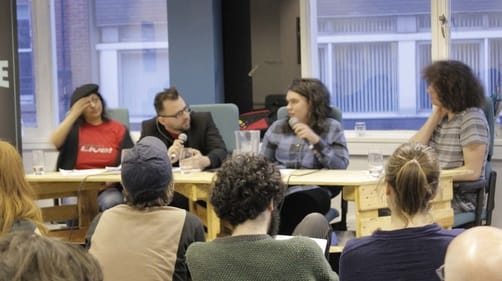
I am a member of Open Rights Group and the IWWFJU. Recently, as acting secretary, I helped to revitalise the IWW branch for my sub-region and am part of Acorn renters union, as a tenant in social housing – where I largely work from home while caring full-time for Jane (who was disabled by M.E. caused by Covid), the centred care of my childhood standing me in good stead, and my rejection of cognitive dissonance in consuming animal products from an early age probably preparing me to resist going "back to normal" as both Covid denialism and climate denialism are funded by capitalists who protect their economic system at any other cost, which I aim to help evidence through an upcoming documentary. As the pandemic continues, I've been involved with my local mask bloc and radical communal care collectives, passionate about the principle of mutual aid – and, as a solarpunk, still trying to dodge those boxes and “do no harm, take no shit.”
"Thankful for what I didn't get...got what I needed instead." – Kelly Lee Owens