

"Until society can be reclaimed by an undivided humanity that will use its collective wisdom, cultural achievements, technological innovations, scientific knowledge, and innate creativity for its own benefit and for that of the natural world, all ecological problems will have their roots in social problems." – Murray Bookchin
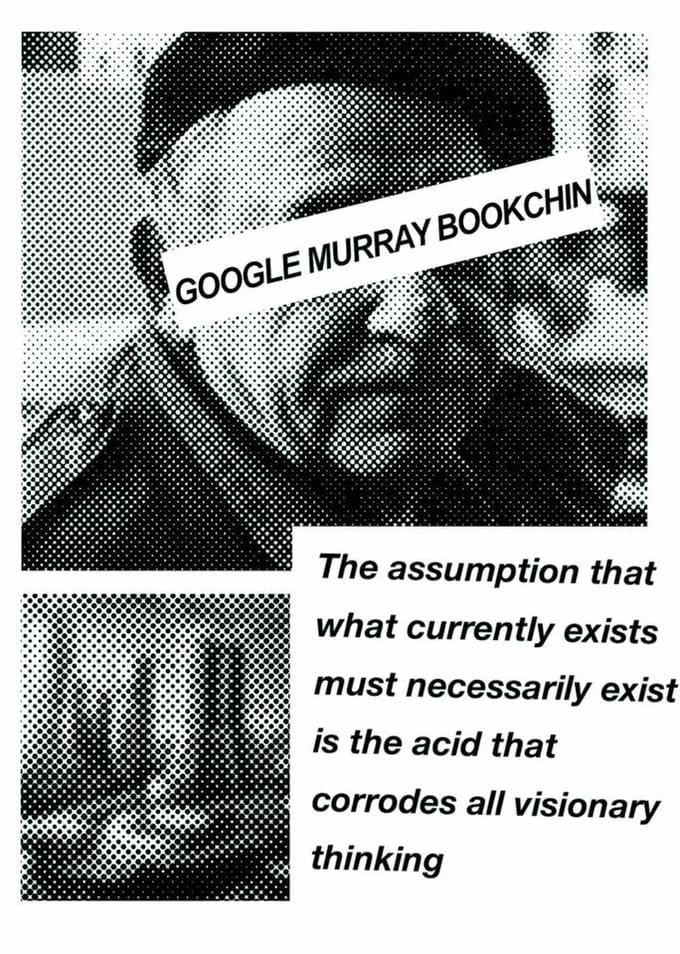


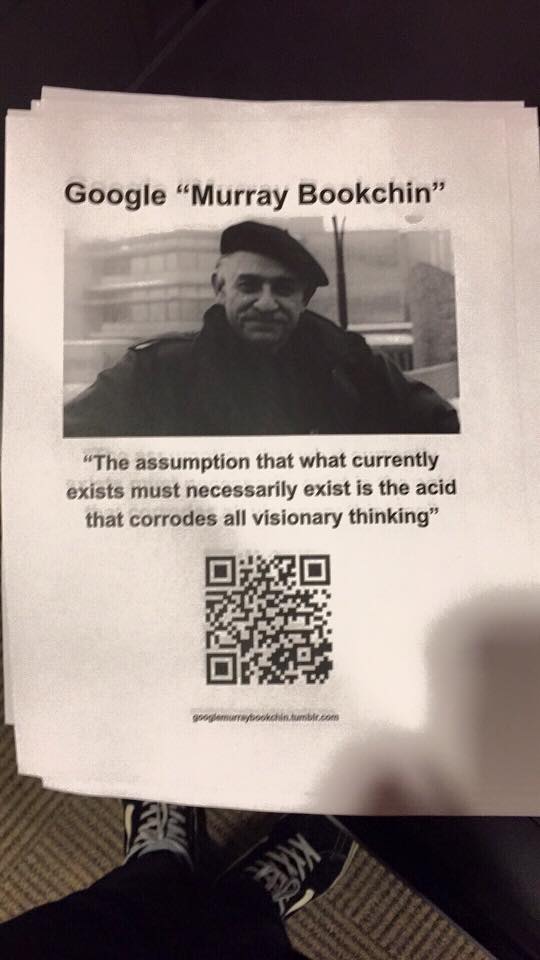

Ten years after his death, Murray Bookchin became an internet meme. "A seemingly unlikely image has become popular in online leftist youth culture," wrote social and political anthropologist Eleanor Finley in her book Practicing Social Ecology: From Bookchin to Rojava and Beyond. "The new generation has portrayed this blue-collar persona in a humorous and, indeed, hopeful light. Memes encouraging people to 'Google Murray Bookchin!'...[portray him as] a cunning grandfather who almost dares the viewer into his utopian way of seeing the world."
What utopia was he proposing? Well, it starts with something he called "social ecology."
In What is Social Ecology?, he wrote: "Power will always belong to elite strata if it is not diffused, in face-to-face democracies, among the people, who are empowered as partly autonomous, partly social beings—that is to say, as free individuals, but as individuals responsible to popular institutions. Empowerment of the people in this sense will constitute a challenge to the nation-state—the principal source of nationalism, a regressive ideology, and of statism, the principal source of coercion." Yes, Murray Bookchin had begun to present us with a clear alternative.
"It was only by reconstructing human society along non-hierarchical, decentralised, cooperative, and directly-democratic lines that he felt society would be able to mend its rift with the natural environment," wrote Connor Owens of the Solarpunk Anarchist blog. "As we started treating each other better, we would start treating nature better. This perspective, in many respects, anticipates what’s now called intersectionality in social justice movements, enclosed within an ecological sensibility."
At "The End of History," We Created Our Own Future: Solarpunk
"We're solarpunks because the only other options are denial or despair." – Adam Flynn
As the Murray Bookchin memes went viral, something else was emerging around the same time, and it all began on an obscure blog written by John Robert, who coined the term "solarpunk." It planted the seeds for an entire movement that still grows today.
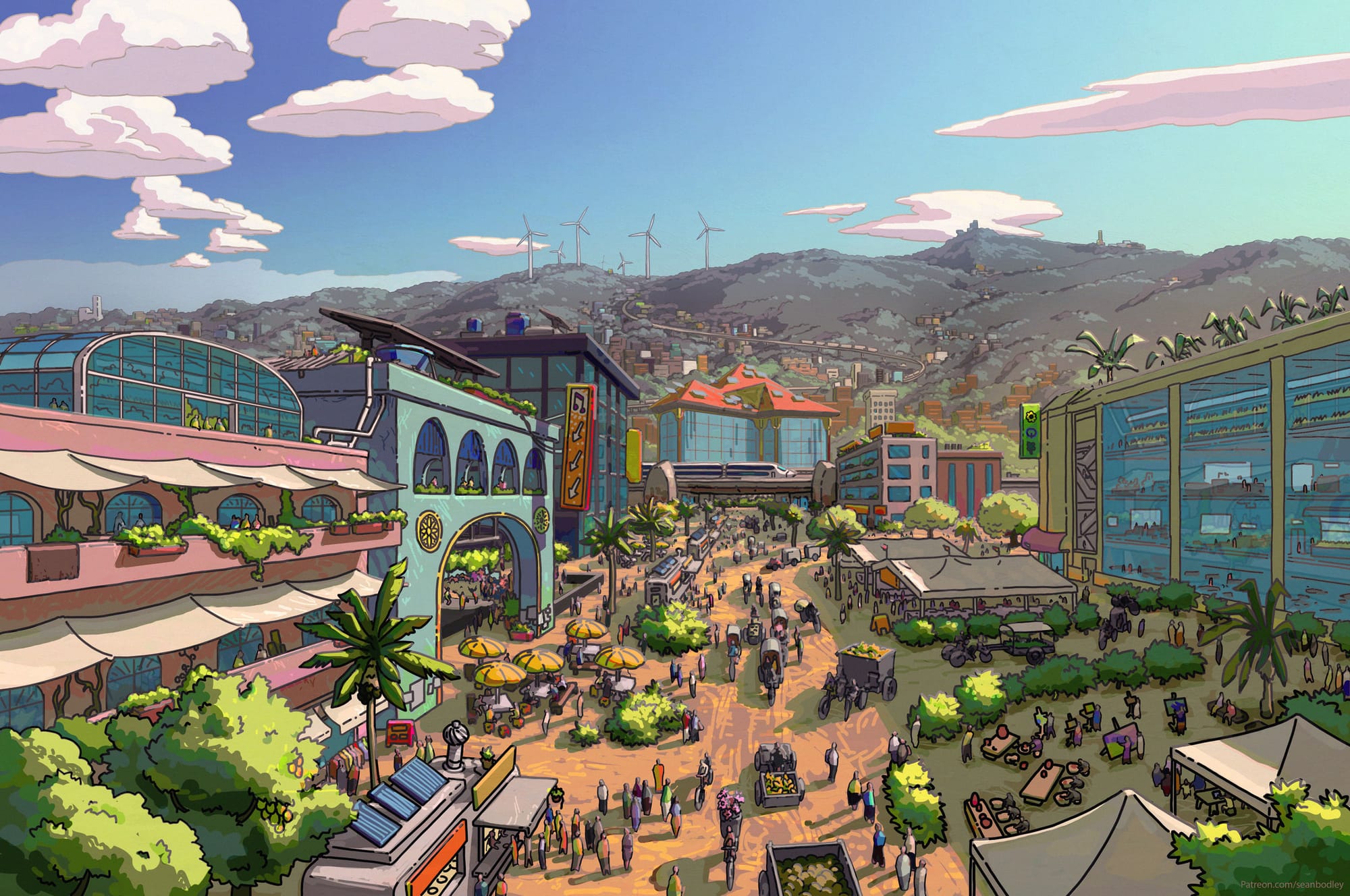
Solarpunk presents us with "a positive future beyond scarcity and hierarchy, in which humanity is reintegrated with nature, and technology is used for human-centric and ecocentric purposes."
"Solarpunk is what made me realise that the future's uncertainty is cause for hope, not despair. It helped me recognise that we have so much untapped potential. Solarpunk is a shining vision of a positive future, a literary and visual genre, and a real movement for change – influenced by a diversity of aesthetics and grounded in our existing world – that emphasises the need for environmental sustainability, autonomy, and social justice. Solarpunk is everything from a positive imagining of our collective futures to actually creating it. It derives its name from the cyberpunk genre, but it aims to go beyond what is to 'what if.' Solarpunk looks beyond the limitations of capitalism and beyond the current rift between humanity and nature, focusing on what we should hope for, rather than on just what to avoid. And most importantly, solarpunk motivates action to build the future today." – Andrew Sage
There's that word again and again: "positive." There's an old saying that positivity never solved every problem, but negativity never solved a single fucking one. "Stress hormones like cortisol and noradrenaline lead to heightened levels of body inflammation and promotes the onset of disease," explained solarpunk science communicator Isabel Richards. "So you're actually doing bad things to your body by being negative all the time." It's not just that it's better for us as individuals, though – it's better for those around us too. It's more inspiring. After all, rebellions are built on hope, not despair.
As I've already covered, the capitalist class openly express disdain for democracy, they despise diversity, equity and inclusion, and they oppose empathy itself; all elements of human society that make life richer for the majority of us. What these nihilistic and dystopian fascists are promoting is misanthropy – they want and need the rest of us to distrust and assume the worst in one another, because it then makes class solidarity and positive social change much more challenging. Just as when we accept hierarchy, when we succumb to these ways of thinking, we are essentially aiding and abetting the establishment.
"The dominant narrative is the one the establishment hopes is dis-abling – that there's no point in trying because it's all hopeless. I think that's the dominant narrative because for most people that is the most effective at disempowering them. Only a few of us will be like, 'Fuck you. I'm doing it anyway,' when we are thoroughly convinced the battle is already lost. I'm convinced the hopeful stories are extremely effective overall for most people in part because they are so actively diminished, suppressed, and reviled not just by the fascists, but by people for whom cynicism or doomerism is the cope that keeps them from having to take action. They don't have to fight because the fight is already lost. But what if it weren't? Then they might have to do stuff. And that is scary as hell." – Susan Kaye Quinn
In a time of late-stage capitalism, solarpunk has offered an antidote to misanthropic "doomerism," with its emphasis on individual "prepping" that inevitably becomes overwhelming for each person – not least because it's almost impossible for any of us to survive alone.
"Mutual aid is and has always been a better strategy during times of crisis than any top-down organising or isolationism. During times of crisis, the social barriers between people break down, as do the laws. Rather than competing for scarce resources, study after study shows that when faced with crisis, people’s natural inclination to work together to solve shared problems wins out. The anarchist, or leftist, approach, or, I would argue, just the rational approach to preparing for crisis is to include other people – friends, family, neighbours, and strangers alike – in your primary plan and your contingency plans." – Margaret Killjoy
They say "it takes a village," and community action is not how a healthy society operates, but it also makes any challenge more manageable – and more hopeful. Hope is a strategy.
My own therapist once explained to me that positivity only becomes toxic when it does us harm – for example, by refusing to acknowledge a problem therefore neglecting possible solutions to it; "I'm really sick, but I don't need any treatment, I'll be okay!" or "They're not that upset, they'll be fine!" when they're clearly really very upset. That's not what we're talking about here; we're talking about hope, which is very different to toxic positivity.
"Solarpunk neither pretends that the problems we face as a species are easily surmountable, nor gives over to despair at their size and complexity. Rather, it focuses on imagining eco-conscious and communally restorative solutions, along with the inevitable struggle we’ll have to undergo to achieve them." – M L Clark
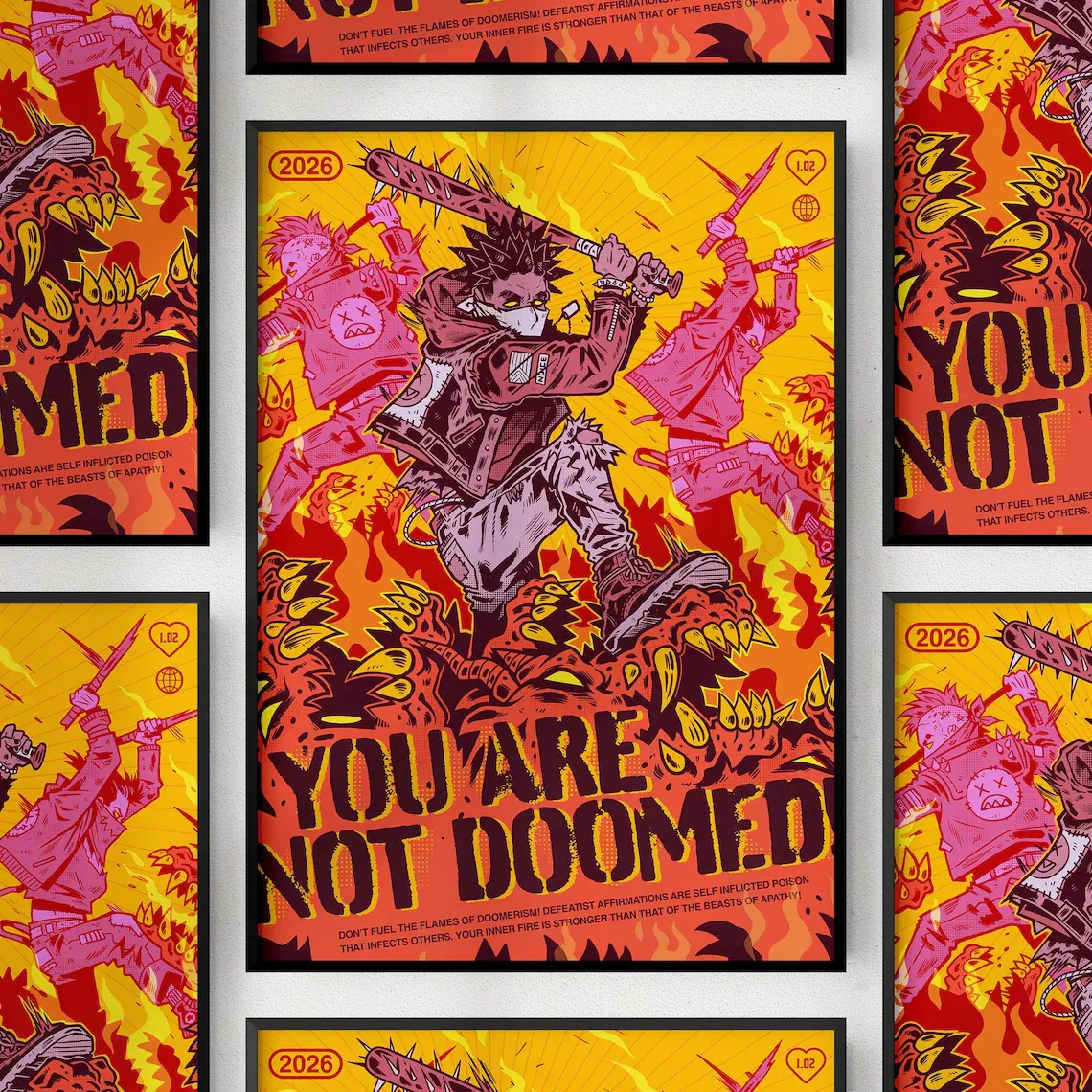
This may be why it has been argued that optimism and pessimism can be two sides of the same coin, and contrary to what supposed "realists" claim, hope is the actual in-between point: it recognises the challenges we face and presents ways of overcoming them, whereas optimists and pessimists alike suggest that things are somehow fixed – either "It'll all work out okay!" or "We're doomed!" – which allows us to divorce ourselves from the process. And doing that is not only disempowering, but increases the likelihood of things not changing in the way we'd prefer.
We can have a post-capitalist, post-growth world working with nature rather than in opposition to it; a world powered by sustainable green energy; a world without leaders, states, or borders; a world with “work” and finance replaced by simple acts of communal care; a world in which individuals can collaborate together to create and control their own collective organisations federated and democratically coordinated (rather than competing) with one another; a world where communities act locally but think globally; a world connected through accessible public transit; a world without desperation, crime, police, prisons, or powerful institutions, and where people’s needs are met through the principle of mutual aid, alongside community support systems, conflict resolution, restorative and transformative justice…and direct democracy.
We can have that world, yes, but we have to get busy building it. A cure for grief is action. As mentioned, many people like myself and my Disabled partner who felt left behind in the rush back to business-as-usual at the start of the Covid pandemic joined together and engaged in mutual aid through mask blocs, and I have been in awe of Covid-conscious communities organising locally and internationally. "We’re showing that there’s hope and liberation on the other side of a realistic risk assessment – and there’s no need to pick and choose safety based on the criteria set by capitalist forces," wrote British-Sudanese artist UMNIA. "The empowerment found in looking after each other is the empowerment of all good movements – there is no need, ever, to leave a single soul behind. Good movements sustain themselves with big imaginations for good now’s and good futures - and being part of the Covid-conscious community, signalling my belonging to the group in any and every way I can, is my message to the world that I don’t want to go back in time, I know we can do better, and that a good future is coming. We will make it so."
"To be hopeful in bad times is not just foolishly romantic. It is based on the fact that human history is a history not only of cruelty, but also of compassion, sacrifice, courage, kindness. What we choose to emphasise in this complex history will determine our lives. If we see only the worst, it destroys our capacity to do something. If we remember those times and places — and there are so many — where people have behaved magnificently, this gives us the energy to act, and at least the possibility of sending this spinning top of a world in a different direction. And if we do act, in however small a way, we don’t have to wait for some grand utopian future. The future is an infinite succession of presents, and to live now as we think human beings should live, in defiance of all that is bad around us, is itself a marvellous victory.” – Howard Zinn
It may not be a coincidence that solarpunk was exploding around the world at the same time those Murray Bookchin memes were going viral. "While the aesthetic-cultural solarpunk movement evolved independently of social ecology, they have so much in common that they could even be regarded as the same tradition by different names," wrote Connor Owens. "Solarpunk’s emphasis on the liberatory and ecological use of technology sounds as if it were ripped straight from the pages of Bookchin’s Post-Scarcity Anarchism in 1971." Andre Rosario, known as "Hydroponic Trash," also pointed out: "To me, social ecology and the ideas in social ecology, communalism, and post-scarcity anarchism are central to solarpunk. The core ideas and beliefs fit together in various ways, and it’s easy to see solarpunk art and connect that back with real-world political action to get us to those beautiful places."
This movement is inherently a countercultural punk rejection of extractive capitalism – with practical, community-level experiments in sustainable living, community, cooperation, and mutual aid instead of extreme individualism, as well as decentralised DIY solutions rather than top‑down control. Howard Zinn was right: the future is an infinite succession of presents. Solarpunk can happen now. It is happening now. Many of us are already getting to work to realise a different way of doing things, to build a new world in the shell of the old, rejecting dystopia and demanding utopia – and, thanks to Murray Bookchin, we have the blueprints for it; social ecology inspired thought, groups, and even entire institutes all dedicated to a theory actually put into practice – as "the alternative to capitalism nobody talks about."
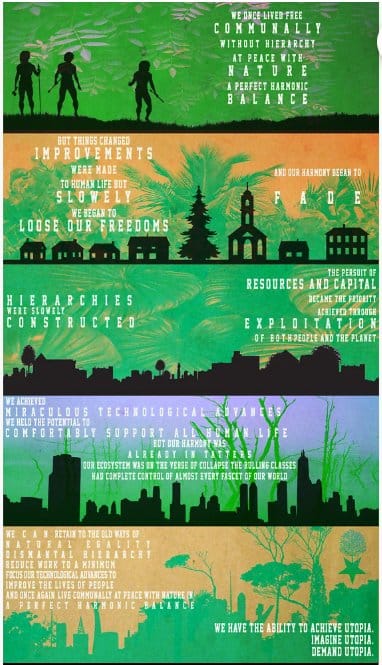
So let's talk about it.
Radical Municipalism
"For many years the left has struggled with the question of how to bring our ideas, of equality, economic justice and human rights, to fruition. And my father’s political trajectory is instructive for the argument that I want to make: that municipalism isn’t just one of many ways to bring about social change — it is really the only way that we will successfully transform society." – Debbie Bookchin
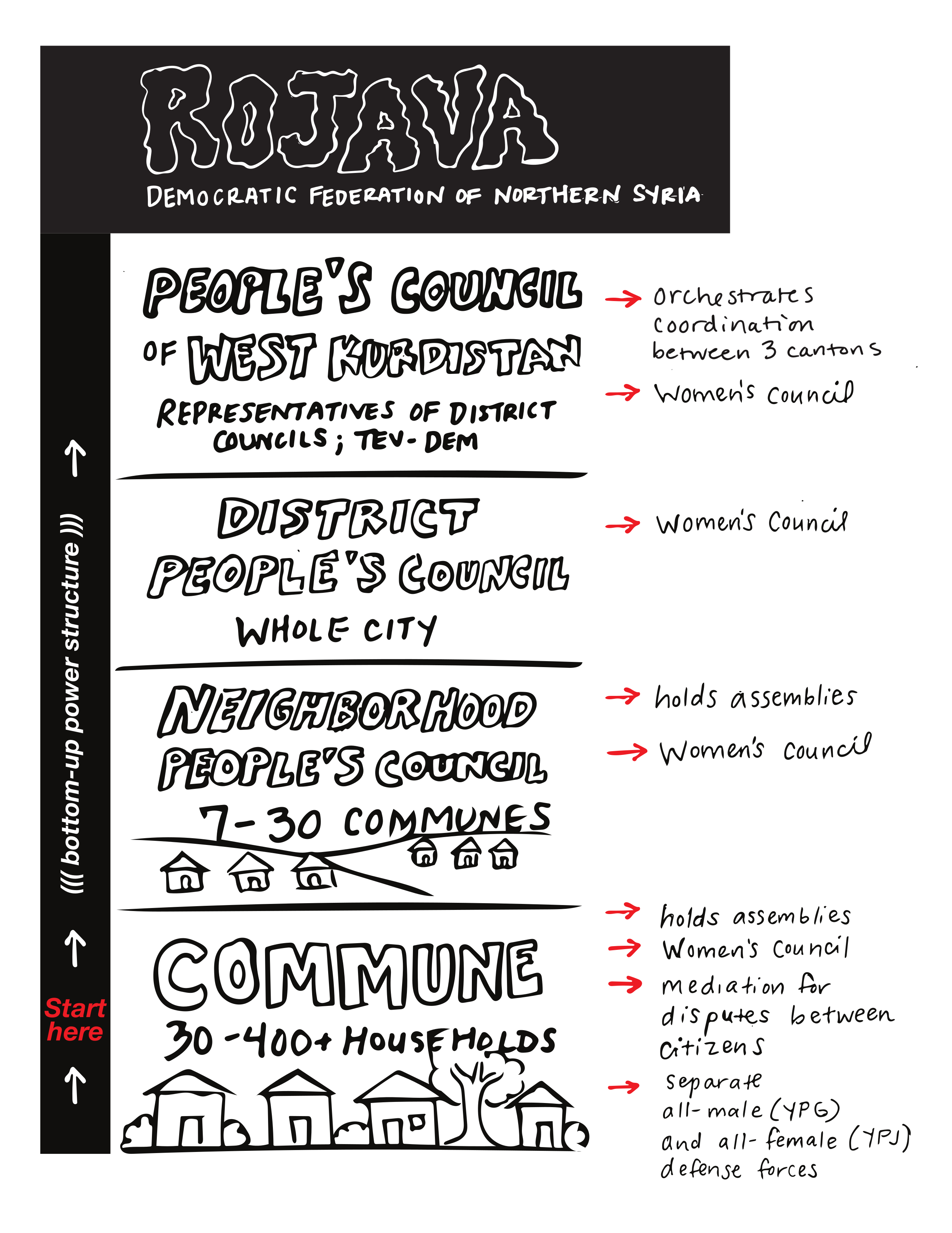
We know that most communities crave more control over their own localities, interconnected with others they can work in harmony with. What Murray Bookchin proposed was beyond anarchism or "libertarian socialism"; instead a libertarian municipalism, with self-governance through local assemblies – communities creating a decentralised political structure in contrast, and opposition to, the state. "Libertarian Municipalism seeks instead to build dual power institutions rooted in direct democracy," explained Emily McGuire. "Rather than attempting to seize or smash the state, this would cultivate societal self-governing capacities through face-to-face assemblies (what Hannah Arendt called 'the lost treasure of democracy'). Instead of withdrawing from the State and power, as is the platform of many anarchist movements, Libertarian Municipalism seeks to build the institutional capacity to repurpose power into an organised liberatory force."
Libertarian – or "radical" – municipalism has been put into practice in places from Jackson, Mississippi and Denton, Texas all the way to the Democratic Federation of Northern Syria, or Rojava.
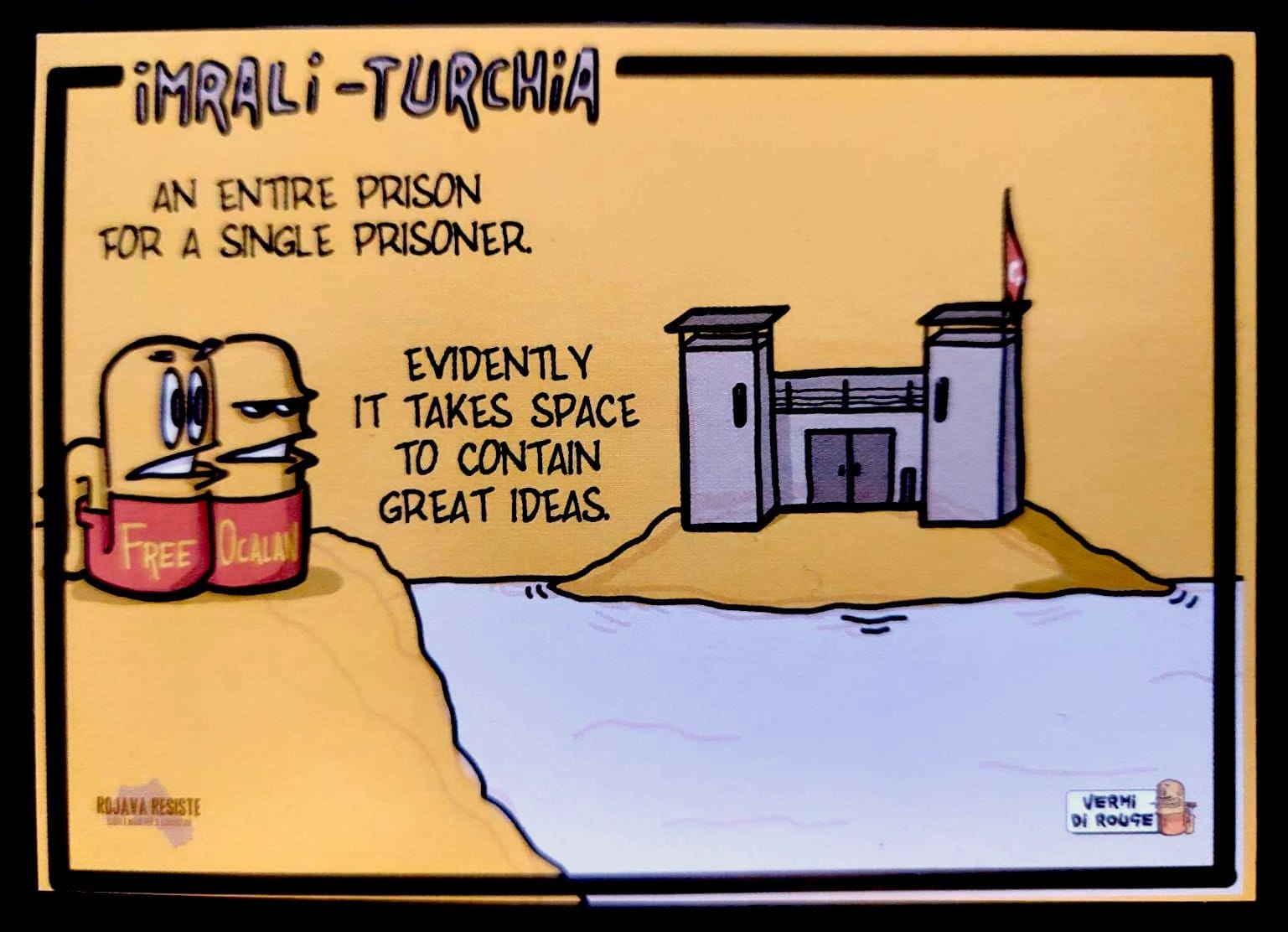
Abdullah Öcalan had led the Kurdistan Workers' Party (PKK) in fighting for an independent Kurdistan and, later, focusing on cultural and political rights for the Kurds.
"The right of self-determination of the peoples includes the right to a state of their own. However, the foundation of a state does not increase the freedom of a people. The system of the United Nations that is based on nation-states has remained inefficient. Meanwhile, nation-states have become serious obstacles for any social development. Democratic confederalism is the contrasting paradigm of the oppressed people." – Abdullah Öcalan
The PKK were deemed a "terrorist" group by the Turkish government, and Abdullah Öcalan was serving a life sentence in solitary confinement on an island off the Turkish coast where he abandoned Marxist-Leninism and wrote to an old and sick Murray Bookchin, telling him he considered himself his "student." Bookchin replied: "I beg you to understand that I am...very frail. I can no longer sit before a word processor for hours and write articles or even letters ...I am obliged to spend much of my time in bed. As such, I am not in a position to carry on an extensive theoretical dialogue ...I deeply regret the loss, but have increasingly come to terms with the inexorability of ageing and mortality." Bookchin passed away shortly after. However, his ideas lived on – not only through Öcalan but subsequently out through the walls of İmralı prison in the Sea of Marmara where he remained the only prisoner.
The people of Rojava built a society based on the teachings of Abdullah Öcalan, who had become an iconic figure in that part of the world and whose ideology of democratic confederalism shaped the region's society and politics. Against all odds, for years Rojava was "a ray of hope in Syria’s dark civil/proxy war," explained Emily McGuire, having successfully scaled up direct democracy among a population of almost five million people, half of which were refugees or internally displaced peoples – and all despite widespread deforestation by Syrian regimes and permanent risk of drought due to restriction of rivers by the Turkish state and destruction of water sources by ISIS, who also kept them constantly under siege. In Rojava, with women's rights and equality at the heart of the system, diverse peoples and faith groups took part in decision-making, with a respect for the environment and ecology remaining core values. Imagine if more people had known about, supported, and replicated Rojava's incredible system of democratic confederalism.
"As people like Murray Bookchin and Abdullah Öcalan have highlighted, the nation-state model sustains itself on the logic that nature – and colonised peoples – are things to be conquered, assimilated, dominated, and exploited. This logic was further supported through the capitalist and extractive modernity by asserting that the only way to organise lives is that of a centralised government that could help reach ‘welfare’ to the ‘masses.’ This has been used as a justification for taking over territories of Indigenous peoples and local communities for nationalist goals like ‘development’ and security." – Shrishtee Bajpai and Ashish Kothari
Radical municipalism provides us with a tangible example for how society can be organised, and how it’s needed everywhere – lest it be marginalised like Rojava.
Perhaps we can also be inspired by radical municipalism itself to actually create a way of increasing awareness of it.
Media as Mutual Aid
After I had experienced both the downfall of Indymedia and the traumatic SilenceBreaker Films debacle, before I got therapy (and "Googled Murray Bookchin"!) it was too easy to be swept away in rhetoric about needing "stronger leadership" in order to avoid repeating such failures – and for a time I acted in accordance with those narratives while I defiantly set up and initially sat on the board of directors for SilenceBreaker Media, a not-for-profit limited company where we attempted to become more financially but also socially and environmentally sustainable by focusing on reconditioning computers, installed with Linux, to help get people online and making their own multimedia, under the slogan “connect, communicate, change.” We even devised – and piloted – a news app, and a social network alternative to Facebook called “The Intersection.” But the "SilenceBreaker" name had become far too associated with me as an individual to the point people always assumed I was the "boss," so while I continued to run my "SilenceBreaker" projects on a personal level, the company instead became known as Libre Digital. However, rejecting hierarchy required more than a name change – more fundamentally, it needed an operational change as well, so some of us (unsuccessfully) attempted to convert it into a co-operative.

You might think the cooperative model might be where we inevitably arrive when searching for effective media by and for the people but, truth be told, even this has its limitations. Finding non-hierarchical ways of working is crucial, and there are some impressive examples of media co-ops in the U.K., the U.S., and elsewhere, but they still have to compete in the commercial marketplace, with little protection for horizontal organisations under capitalism, and if there’s one thing you can say about capitalism it’s that it is highly adaptable: the system has ironically co-opted many co-ops to still exist within the capitalist economy (and that famous cooperative The Associated Press even cooperated with the Nazis). In addition, establishment media loves little more than to lure and indeed co-opt clout-chasing voices of “dissent” determined to further their individual careers for greater financial security, leaving the journalists within cooperatives, as individuals, subjected to the capitalist economy and its corruptible seduction. Journalism, as mentioned, is a class-exclusive profession, largely a landscape for the “brightest and best” who want to get ahead and are therefore compelled to compromise.
"The core business of the plaintiff is to deliver ads to its visitors. Journalistic content is just a vehicle to get readers to view the ads." – lawyer for multinational mass media company Axel Springer
So while democratising the economy where we can remains important, media by and for the people must transcend the economy. After all, it shouldn't just rely on money to exist. With prefigurative politics in mind, we have to be the change we wish to see in the world, and that means creating an information network that can be part of our social fabric, standing the test of time and not just transcending markets, but also borders and nations.
I've talked a lot about mutual aid – a voluntary, collective exchange of resources and services for common benefit in overcoming socio-economic barriers, and these resources often include food, clothing, medicine, even education and information, prominent in times of crisis like climate collapse and the Covid pandemic, but also meeting the daily needs of communities without relying upon the establishment. Media can, and must, be a part of this.
Now, proposing we de-commodify and de-professionalise journalism may seem like a strange proposition at first. As discussed, journalism is quite a class-exclusive profession and, as I also cited earlier, even Tim Knight emphasised the importance of the professional standards of journalism. We have examined the terrible consequences of journalism in the global economic system, yes, subjected to the influence of corporate and state bosses. However, this isn't only a matter of choosing to reclaim the media because we have little to lose. No, this is a matter of principle. A matter of survival.
For example: Do we believe that any and all art can only truly be of value or importance if its end product sells at a high price? Do we believe there is no value to art for art's sake? Or do we believe in a world where art, and multimedia, is an inherent part of our culture, our society, and our way of life? If we do, and if information is a human right, then why is journalism being ring-fenced off from the masses who are largely treated as children too irresponsible and incompetent to ever offer any journalism of value, instead told to shut up, sit down, and simply consume information from the class-exclusive group of "experts"? Yes, journalism takes skill. So does music – but do we dismiss all of the skilled musicians in the world performing for fun? Skills can be learned and honed, without them having to be through Oxbridge universities, where only people from certain class backgrounds can make the grade, lacking lived experiences of most working class people from diverse backgrounds.
"Tearing down the walls between performer and audience, artist and viewer, author and reader, has long been a liberatory goal." - Shuli Branson
We know there is another way. One where all involved, including the service users, are empowered, with little division between news “reporter” and news “consumer,” and such hierarchy removed completely – truly mutual aid media: people reporting and consuming information with, by, and for one another as an essential service; the very oxygen of organising our society. And no, it doesn't have to be unskilled or irresponsible. There can be standards, checks and balances.
Mutual aid media already exists today to provide us with some inspiration.
Citizen Journalism with Checks-and-Balances
To reflect all of our communities at a grassroots level, the ideal media model simply must largely rely on citizen journalism where information is seen less as what it became mistakenly accepted as (a commodity) and more of what it truly is (a human right). While rejecting the elitism and professionalisation of modern journalism, we can learn from the mistakes of Indymedia and build something new.
While establishment media reinforced the capitalist status quo and hid behind the excuse of “impartiality” when regularly refusing to critique capitalism’s brutalisation of our communities, citizen journalism today empowers ordinary people in extraordinary ways from the ashes of Indymedia, presenting us with inspirational examples of how we can effectively disseminate counter-propaganda, or agitation propaganda ("agitprop") while still retaining and developing journalistic standards.

Based on (and named after) the principles of mutual aid, the French-language Reseau Mutu, or Mutu Network, is comprised of over twenty websites dedicated to local radical news, located in various areas of France, in addition to Switzerland, Belgium, and recently expanding its reach even further to help spawn similar sites across Europe.
The Mutu model has succeeded through a transparent editorial process based on set principles that are not just founded on mutual aid but are also anti-establishment, anti-authoritarian, and anti-fascist at their core. While it has grown fast, there are some activists who feel the separate websites repeat more general information and ideas that do not require an entirely different site. Nonetheless, it further demonstrates the potential for citizen journalism, even if not utilising a similar web platform. Numerous other examples exist, offering different approaches to learn from. Cerveaux non Disponibles, also based in France, quickly soared in popularity with the growth of the Yellow Vest movement and have said "the communication of information is really one of the keys of the war." In Latin America, Avispa Midia was inspired by the Zapatistas and state that "media is a terrain of struggle, where we must confront the commercial and hegemonic media."
There are media activists around the world, gathering, collecting, and sharing information, through imagery, interviews, and truly fearless journalism; speaking truth to power. On demonstrations week in and week out, protesters are filming police to hold them to account in ways their powerful chiefs and their friends in establishment media rarely ever do. This is not a recent phenomenon. When we reflect on citizen journalism's impact, we have much to be thankful for over the decades, from George Holliday’s incredible documentation of the Rodney King assault, to the "Burma VJ" video journalists, the mobilisation of entire movements such as Black Lives Matter, Occupy Wall Street, the Arab Spring, and resistance to ICE. So impactful are media activists that many, such as Samir Flores Soberanes, are even killed over it.
Yes, many of these causes have heavily relied on the utilisation of corporate-controlled social media as the means to an end. But now even those means are being seized. Because something else emerged with solarpunk and those Murray Bookchin memes.
"[Murray Bookchin] also rejected the notion that there was anything inherently anti-ecological about technology, claiming that technology – or 'technics', borrowing a term from Lewis Mumford – could be used for good or ill depending on whether they were utilised for democratic/decentralist or authoritarian/hierarchical purposes. Bookchin, and other members of his Institute of Social Ecology, argued that technics such as fossil fuels and nuclear weapons are coded primarily for authoritarian purposes, while solar and wind power, as well as micro-manufacturing, are more coded for participatory purposes, enabling communities to become more self-reliant and less controllable by the the powers of the state and capital. We should therefore seek to use decentralist and ecological technics to enhance human and nonhuman well-being." – Connor Owens
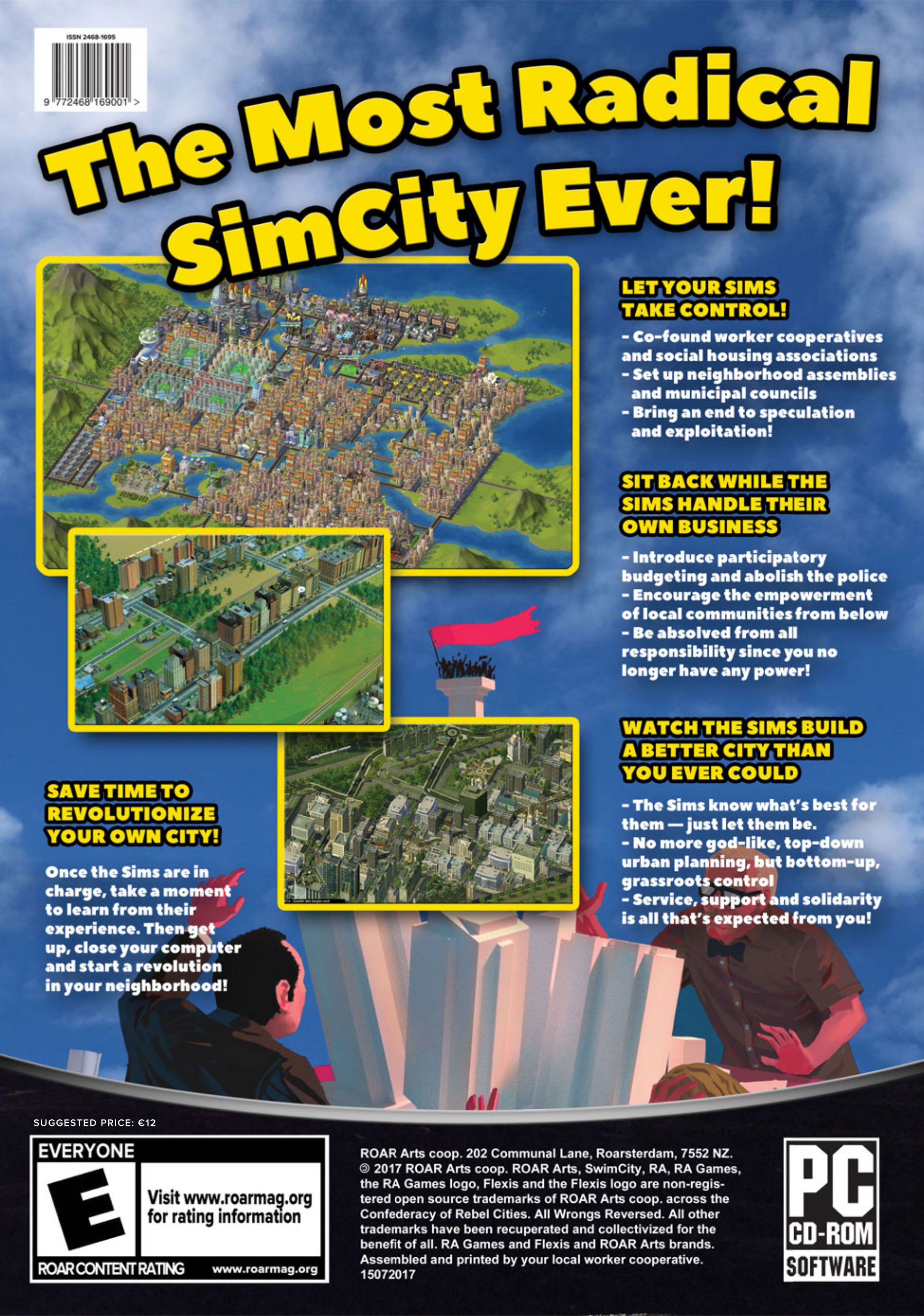
Seizing the Means of Social Media
An innovative federated universe (or “Fediverse”) of decentralised online social networks became the ideal counter-cultural adversary for Elon Musk, Mark Zuckerberg, and the fascist "tech bros."
“Enter the Fediverse, an alternative, open-source social media network that aligns with anarchist values. Rather than being a thinly-veiled attention and data gathering capitalist vortex, the Fediverse is an actual social network, built out of a multitude of federated, autonomous, and decentralised instances. On the Fediverse, we control the infrastructure, we moderate ourselves, and we can gather and share based on our affinities and desires rather than being guided by addictive algorithms. Many anarchists who have dodged the traps of corporate social media are already here, sharing their projects, art, and ideas.” - from the Fedizine
The Fediverse really brings us back to the spirit of zines that arguably inspired the web and blogosphere in the first place. It's not a coincidence that again and again and again, zines are even made about the Fediverse itself. There are many commonalities. With a counter-cultural spirit and anti-corporate ethos, the Fediverse has a wide range of collectives often with an emphasis on shared interests, connecting people from different parts of the world just as zines often have, while offering Mastodon as an alternative to Twitter, Pixelfed as an alternative to Instagram, PeerTube as an alternative to YouTube, and so on – but each site all largely able to interconnect and interact with one another to varying degrees, free from corporate walled gardens (or rather, conference suites) that ruined our web in the first place.
Considering the absence of profit motives, ads or algorithms of a cynical nature, you can barely even imagine a more fitting opposition to the walled-off corporate conference suites of Twitter (or “X”), Facebook (or “Meta”), and the like.
“The Fediverse is a collection of decentralised social media services that interconnect via ActivityPub, a specification from the World Wide Web Consortium (W3C). The Fediverse is nothing short of a renaissance on the social web because, for the first time in well over a decade, social media has a chance to be truly decentralised. This has massive implications for developers; it may be the best open platform opportunity since the blogosphere in the early 2000s.” - Richard MacManus
Indeed, we lost our way. But we can find our way back – armed with the knowledge gained from the mistakes of Indymedia and the hegemony of corporate, centralised social sites. The way in which the Fediverse exists as an entity reflects the vision many of us cite for society in general, with its immense potential for de-commercialised spaces and decentralisation. So appealing are these concepts to humans at our core – and so at odds with the current economic status quo – that as governments increase their restrictions on the internet while perhaps not coincidentally entrenching the dominance of the "Big Tech" companies, the billionaires are meanwhile attempting to do what capitalists always do with art and, as mentioned, with media: they're trying to co-opt them, of course.
Become Ungovernable – and Unco-optable
“Twitter is the closest thing we have to a global consciousness,” said Jack Dorsey as Elon Musk emerged to purchase the service, before continuing: “In principle, I don’t believe anyone should own or run Twitter. It wants to be a public good at a protocol level, not a company. Solving for the problem of it being a company however, Elon is the singular solution I trust. I trust his mission to extend the light of consciousness.” After the sale of Twitter to Musk, Jack helped spearhead the Twitter spin-off Bluesky, aiming to capture those leaving Elon’s Nazi platform with a clone app “cosplaying decentralisation” and lacking the distributed networks of the Fediverse. Is Bluesky a breath of fresh air after Musk seized control of Twitter? Sure, but that's a low standard. Does it remind us of the Twitter of old? Of course, but what will ultimately stop it from suffering the very same fate?
Meanwhile, Zuck’s Meta held meetings with Fediverse administrators, apparently with a view to plug his Threads system into it, provoking a Fediverse Pact of admins pledging to never federate with his poisonous sites. And this federation is part of the beauty of it: while Trump's vice-president JD Vance joined Bluesky and its users frantically attempted to organise to shut him out with suggestions to simply ignore him and his fascist followers in the hopes they'd one day go away, Fediverse servers whose code of conduct have rules against fascism would either not approve his registration in the first place, or simply de-federate from any server that did.
"Bluesky sure seems like a lot of fun! They've pulled tens of millions of users over from other systems, and by all accounts, they've all having a great time. The problem is that without federation, all those users are vulnerable to bad decisions by management (perhaps under pressure from the company's investors) or by a change in management (perhaps instigated by investors if the current management refuses to institute extractive measures that are good for the investors but bad for the users). Federation is to social media what fire-exits are to nightclubs: a way for people to escape if the party turns deadly." - Cory Doctorow
Nothing Good Comes Easy
Bluesky's Twitter 2.0 model, it is often argued, is more intuitive for ex-Twitter users, and therefore easier to use than Mastodon. The codes of conduct will play a part in this too, even if users don't realise it: in spaces such as many servers on Mastodon, the standards are often just plain higher; people push for more inclusive language, and alt text on images is constantly requested (and rightly so).
One representative from a workers' organising group actually told me personally that she was reluctant to have a presence for their guild on Mastodon because of such standards. "It was a rather negative experience for me personally - like how it felt was to go from 'The internet is amazing because it's full of amazing people who build amazing things!' to 'Nevermind, the internet sucks, and people are the reason that people can't have nice things' in like the span of 24 hours," she told me. "I love the idea of Mastodon. I want Mastodon to be a thing, and I want to be a part of it being a thing. But my experience has made me afraid that I'm not allowed to be a human being who makes mistakes on there. And boy do I make a lot of mistakes." She clarified: "Basically the primary thing that I feel is not a good match for Mastodon - like not a good match for me trying to take it on myself in addition to all the other things, is I'm not always able to attach alt text to images. Sometimes I forget, sometimes I literally run out of time." She concluded: "My alt text for stuff is simply copy/pasting the words that are on the image into the box...that is all the people on the Big Tech platforms seem to expect from me."
Aside from putting some of her own minor inconveniences above the major inconveniences of, in this case, Disabled people, surely none of us anti-capitalists really think "people" are fundamentally shitty at heart? Isn't that misanthropy what the capitalist class prefer us to buy into? We want to strive to do better, to be better, to be the change. Of course being called out isn't always easy to take, and it isn't always delivered in the gentlest way, for various reasons, and some of us would rather not keep learning (and unlearning) because it's easier to stay in our comfort zone – such as, yes, the Big Tech sites.
"Working and living inside hierarchies does not teach us how to deal with conflict. Most of us avoid conflict either by submitting to others' wills and trying to numb out the impact on us, or by trying to dominate others to get our way and being numb to the impact on others. ...Conflict is a normal part of all groups and relationships. But many of us still seem to think that if conflict happens, it means there is something wrong – and then we seek out someone to blame. ...The emergence of conflict does not have to mean that someone is bad or to blame, and the more we can normalise conflict, the more likely we can address it and come through it stronger, rather than burning out and leaving the group or the movement, and/or causing damage to others." - Dean Spade
In fact, I joined a radical communal care collective via Mastodon, and we held regular online meetings and agreed on Dean Spade's book Mutual Aid as a key guide for us going forward, but when the "founder" (and sole admin) of the group had conflict with another member, and was reminded of the book's section on conflict, he suddenly dismissed it because it didn't suit him. Half of us left, and his group later collapsed "because people" (his words). It's hard to unlearn hierarchy when we're brought up with it in our lives. But suggesting people – human beings – are innately shitty seems like a cop-out too many of us use to justify continuing to do shitty things ourselves. And sadly, it's straight from the capitalist hymn sheet. It's that dreaded misanthropy yet again.
"Do you believe that human beings are fundamentally corrupt and evil, or that certain sorts of people (women, people of colour, ordinary folk who are not rich or highly educated) are inferior specimens, destined to be ruled by their betters? If you answered 'yes', then, well, it looks like you aren’t an anarchist after all. But if you answered 'no', then chances are you already subscribe to 90% of anarchist principles, and, likely as not, are living your life largely in accord with them." - David Graeber
Worth Fighting For
For now, Mastodon will likely continue to be perceived as lesser to Bluesky until the inevitable "enshittification" occurs, at which point more people will (perhaps finally) realise that Mastodon, and the Fediverse as a whole, reflects the world we want, and it's one worth fighting for (yes, even if that includes a little conflict with those of us on the same side along the way).
Fundamentally, private entities are desperately attempting to retain their dominance on the social media landscape. Beyond the billionaires’ ideological motivation to essentially influence public discourse, there is also the obvious base incentive for them, as capitalist endeavours, to sustain their services in order to meet their business aims. While they may enjoy the narrative that us Fediverse users are a small minority on the fringes of a social media world where their sites are still “the places to be,” their recent actions only betray their concerns that there are, instead, more and more people attracted to the core principles of the Fediverse.
Those old social media sites aren’t just facing an existential crisis; they were flawed creations to begin with, built on sand – as mentioned, they were never perfect.
The Fediverse isn’t perfect, either, although it is structured on stronger foundations from the start – foundations compatible with anarchist principles. And as anarchists, we realise that perfectionism is the enemy of good. But we can still try to do better, even in the face of adversity.
For starters, servers cost money, and instances of the Fediverse face a scarcity of resources that the likes of Elon and Zuck don’t have to worry about so much. There are other challenges too. Yes, servers must become more transparent, accountable, and democratic, but that will require more rights alongside more responsibilities for users, if they are so willing. Yes, Nazi punks can set up their own vile servers, but the rest of us will simply de-federate from them, setting them adrift alone; ostracised, as they deserve to be. And yes, even servers with codes of conduct that promote safe spaces for marginalised people have their own problems with ignorance, or lack of understanding of privilege and power imbalances, but unlike X and Meta and sites like them, such instances are often experiencing critical yet constructive, diplomatic discussions about how to improve the form and content of the servers in question, which cannot exist in the first place in centralised, corporate social media – because X and Meta are, inherently, incompatible with democracy. This is why the Fediverse is important to value, nurture, and improve. As difficult as it can be in this time of crisis, we must remember to learn the lessons of Indymedia.
Challenges also arise when speaking about the Fediverse as one entity, when in fact it is, by its very definition, comprised of many different networks alongside Mastodon, like Pixelfed, PeerTube, Castopod, Lemmy, and more, each with different form and content, offering publishing opportunities for text, images, video, music, you name it. These remain crucial tools for a much-needed multi-media citizen journalism at the grass-roots level. But not all software is the same, and this requires consideration.
What was described as a Twitter ”exodus” when Elon Musk took over the service saw swathes of users switching to Mastodon on a matter of principle: they may have wanted a social network that functioned similarly to what they were familiar with on Twitter, but without the corporate ownership and increasingly fascistic culture. Meanwhile, the Reddit boycott was arguably more about Reddit charging third-party developers for commercial access to its application programming interface (or API). Thus, the culture on Reddit alternatives such as Lemmy may be more comparable to Reddit itself, than most Mastodon servers can be compared with Twitter.
"The medium is the message." – Marshall McLuhan
If, like Reddit, a site has an “up-vote” and “down-vote” system on its posts, the discourse is inevitably influenced through that consideration by the user, which is not always useful. The exception is the Beehaw instance, which took away down-votes entirely and indefinitely in an attempt to nurture a kinder culture, based on the logical assumption that if a post brings little to the conversation, it will simply lack up-votes, negating any need for a down-vote feature that can be – and often is – abused on Lemmy, just as it is on Reddit.
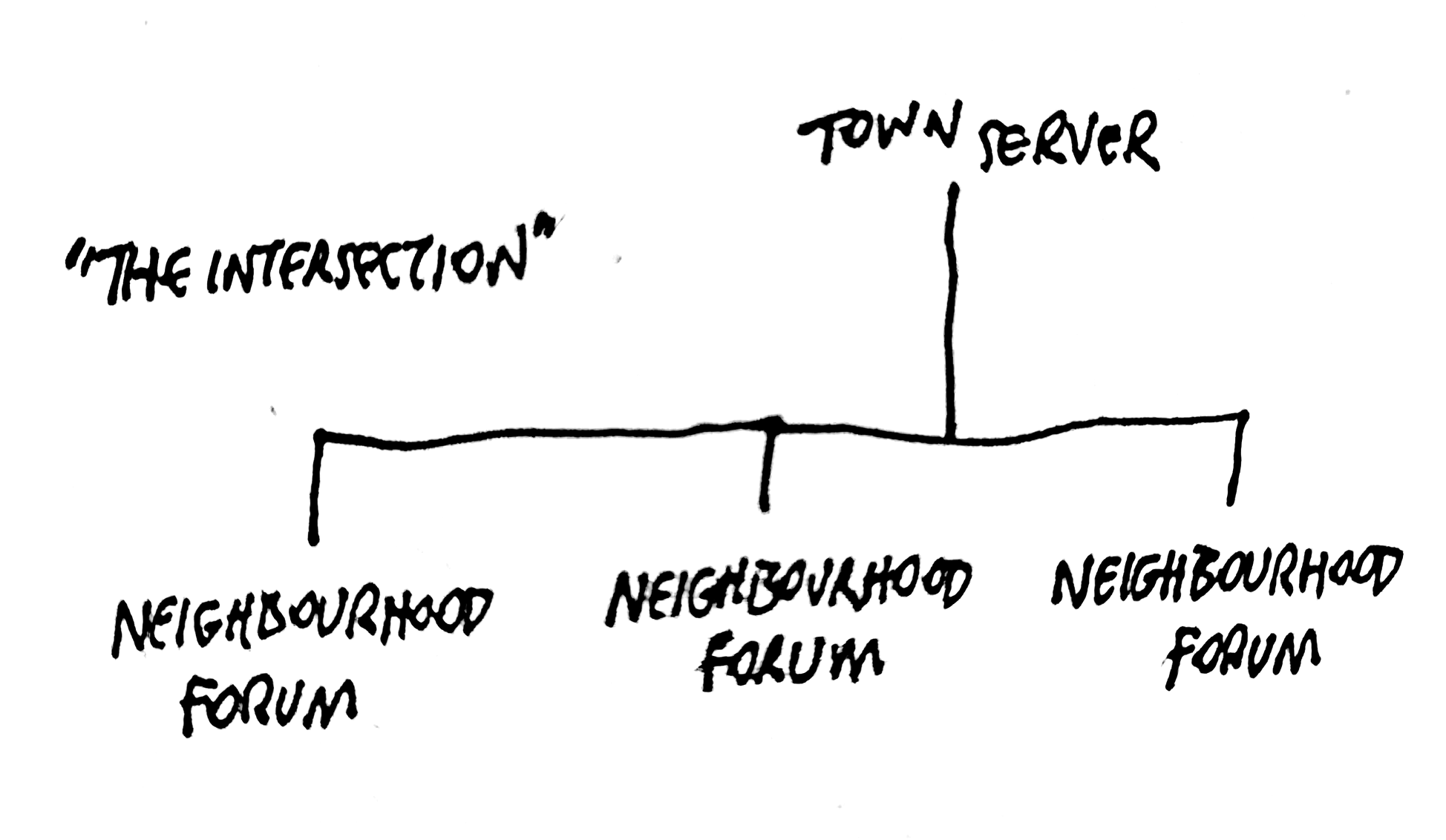
Activists have long called on social movements to campaign “wherever people are” but, morally, that can no longer include the social networks of late capitalism’s billionaires, be it the proverbial Nazi bar of Elon’s X, the misinformation hive that is Zuck’s Meta, Trump's Big Tech enablers, or the next big “tech bro” offering. The Fediverse is ours to utilise, and create. By its very definition, it is collectivism over individualism. By its very structure, it can be order without power. This is why we can utilise the Fediverse to develop our radical media networks – building the new world in the shell of the old; seizing the means of social media.
Forget closed-off Facebook groups and X accounts. Forget about wondering where to find information on the latest meetings, campaigns, demonstrations and resources of interest to anti-capitalists and anti-fascists. With a Fediverse radical media network based on something similar to Beehaw's form and inspired by Mutu's content, we can build a framework to find and disseminate such details – town by town, region by region. Wherever we are that day; getting involved, learning and sharing and changing our communities for the better. Rejecting disinformation and helping people to better understand the principles of mutual aid, tackling the challenges we face, together, in the solarpunk spirit of social ecology. Intersectionality at its core.
I for one plan to do my best to help build this "Intersection." If you'd like to, as well, then contact me. And let's keep communicating via the Fediverse.
(Oh, and if you do carry out a web search for Murray Bookchin, use a search engine other than Google – they're not a verb, just an evil advertising company.)